🤖 Bridge - AI exploration platform for product teams
Own product, built in public


🖥️ The product
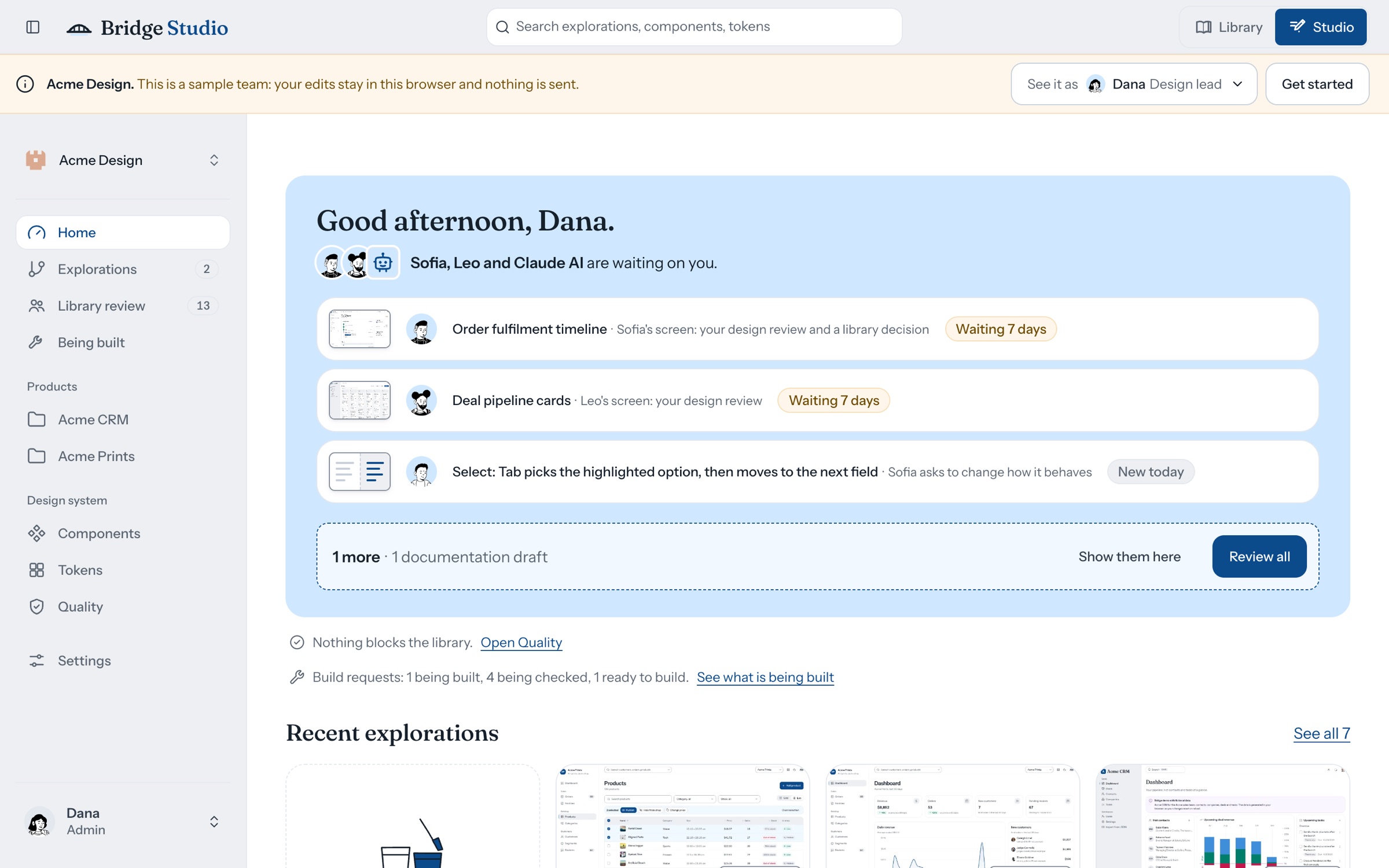
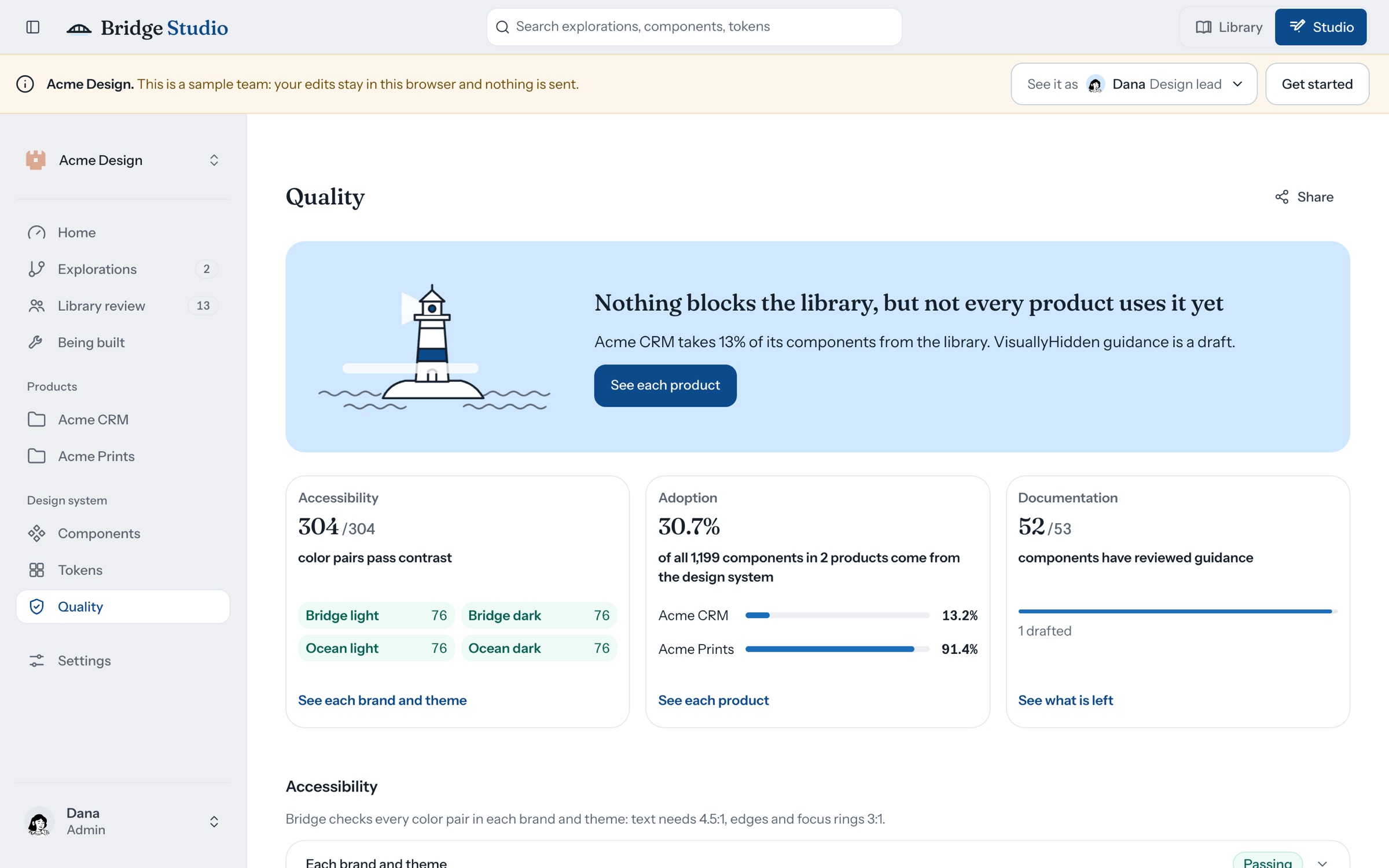
Three roles, three different first screens. A contributor sees only what is waiting on them. A reviewer gets the queue. A lead gets adoption and drift. Nobody is shown a fact they cannot act on.
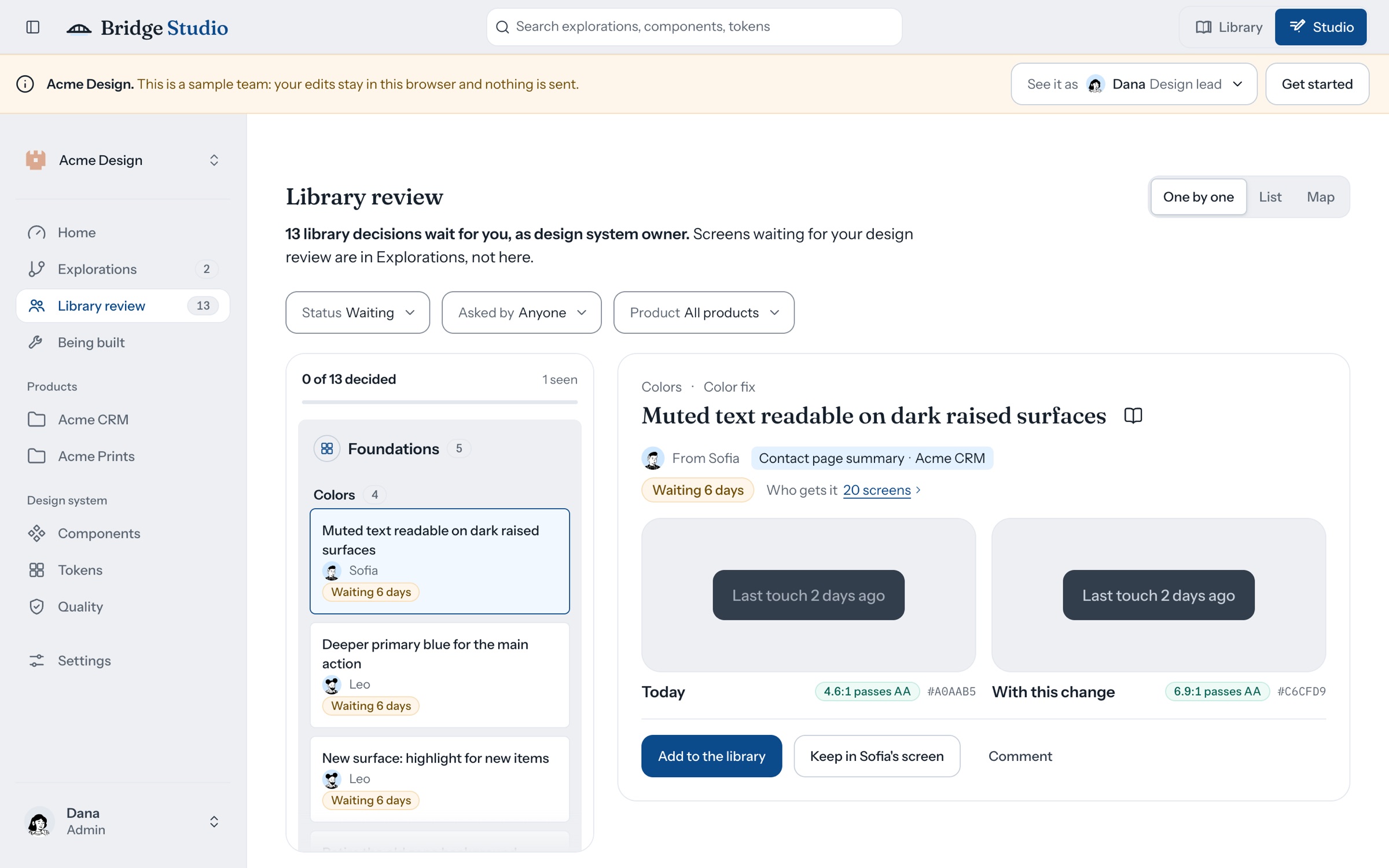
The review is the product. An exploration arrives as a screen, before and after, with the teammate's open question attached and two answers to give: needs changes, or looks right. No diff, no pull request, no code. The developers get it as it is.
🔍 How I framed the problem
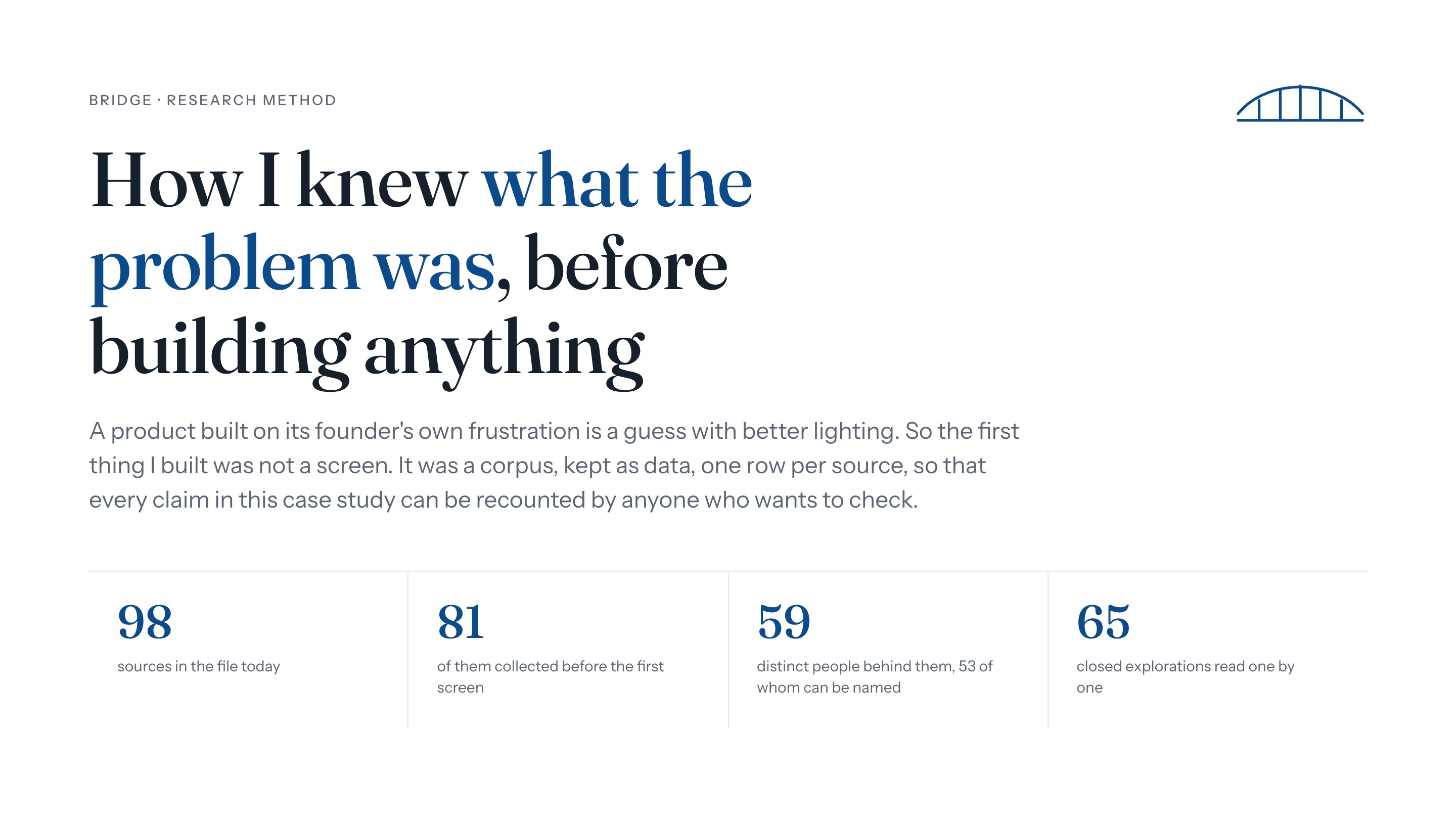
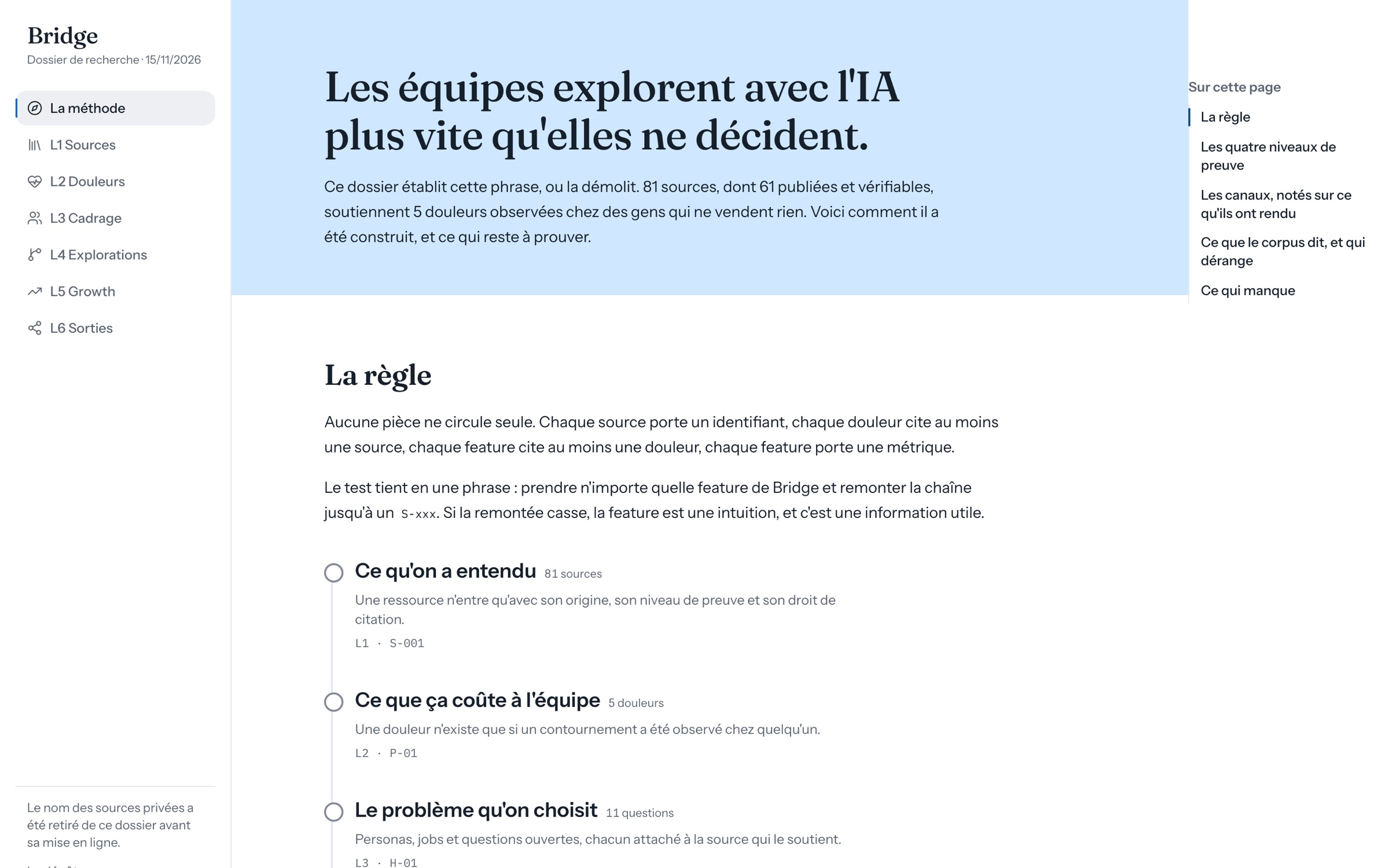
I did not want a product built on my own frustration. Before the first screen, I built a corpus and kept it as data, one row per source, so every claim can be recounted.
| What I based it on | How much |
|---|---|
| Sources in the file | 81 |
| Distinct named witnesses | 43 |
| Named organisations | 47, of which 38 are neither platforms nor research publishers |
| Sources at the highest evidence level | 61 of 81 |
| Citable by name | 62 (17 anonymised, 2 private) |
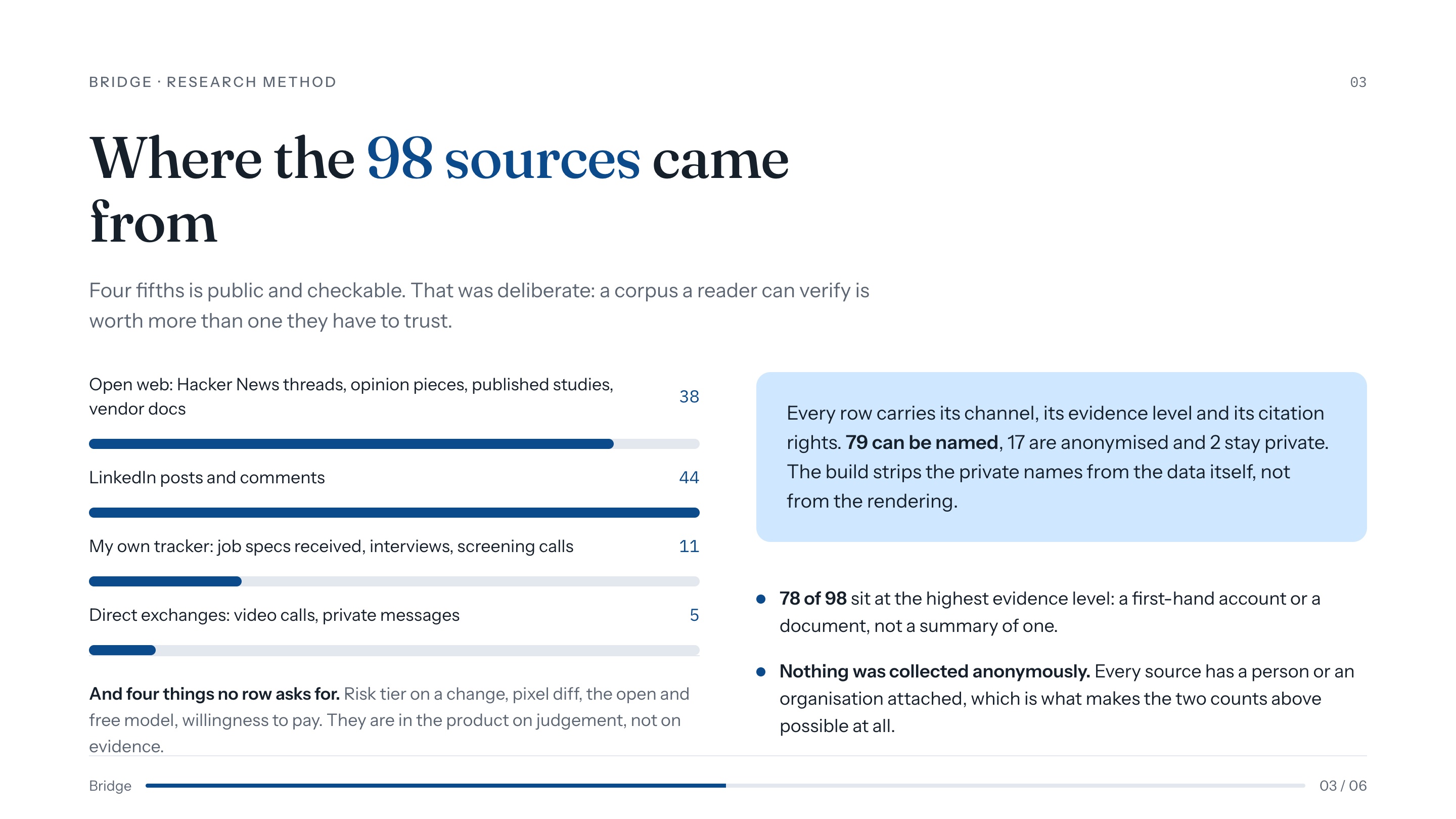
Where it came from matters as much as how much:
| Channel | Sources |
|---|---|
| Open web: Hacker News threads, opinion pieces, published studies, vendor docs | 38 |
| LinkedIn posts and comments | 27 |
| My own tracker: job specs received, interviews, screening calls | 11 |
| Direct exchanges: video calls, private messages | 5 |
Two thirds is public and checkable. That was deliberate: a corpus a reader can verify is worth more than one they have to trust.
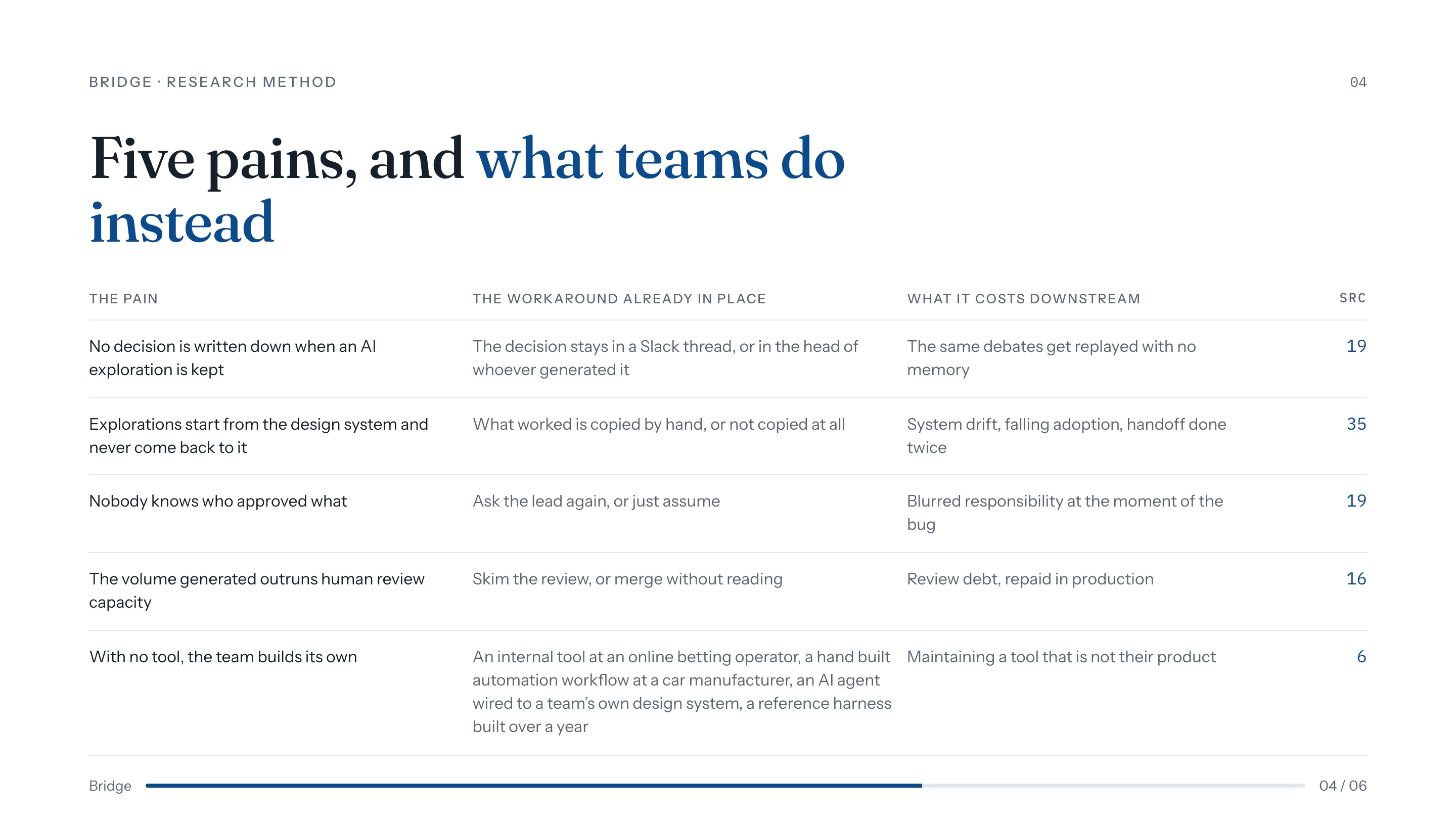
🩹 Five pains, and the workaround that proves each one
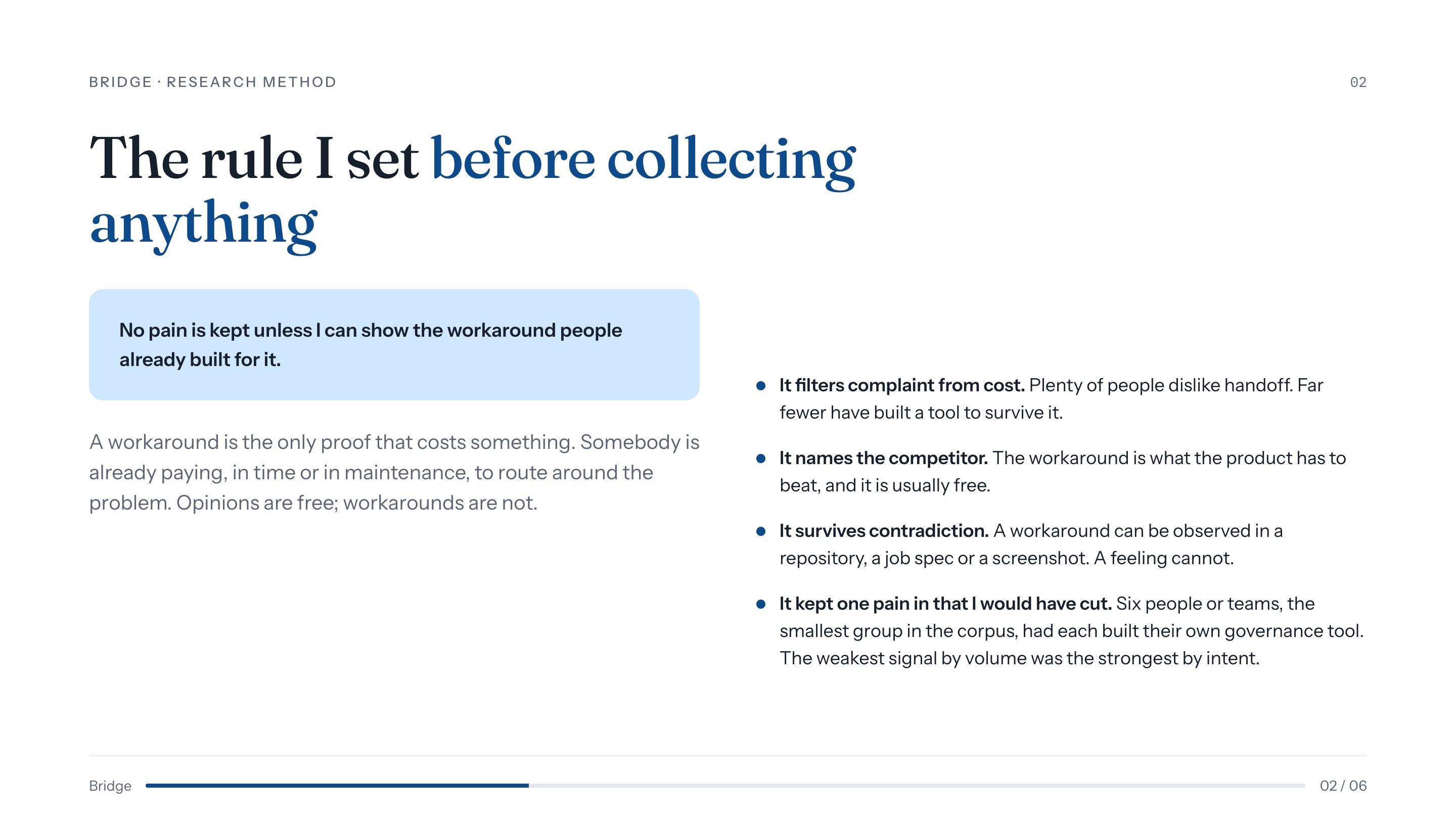
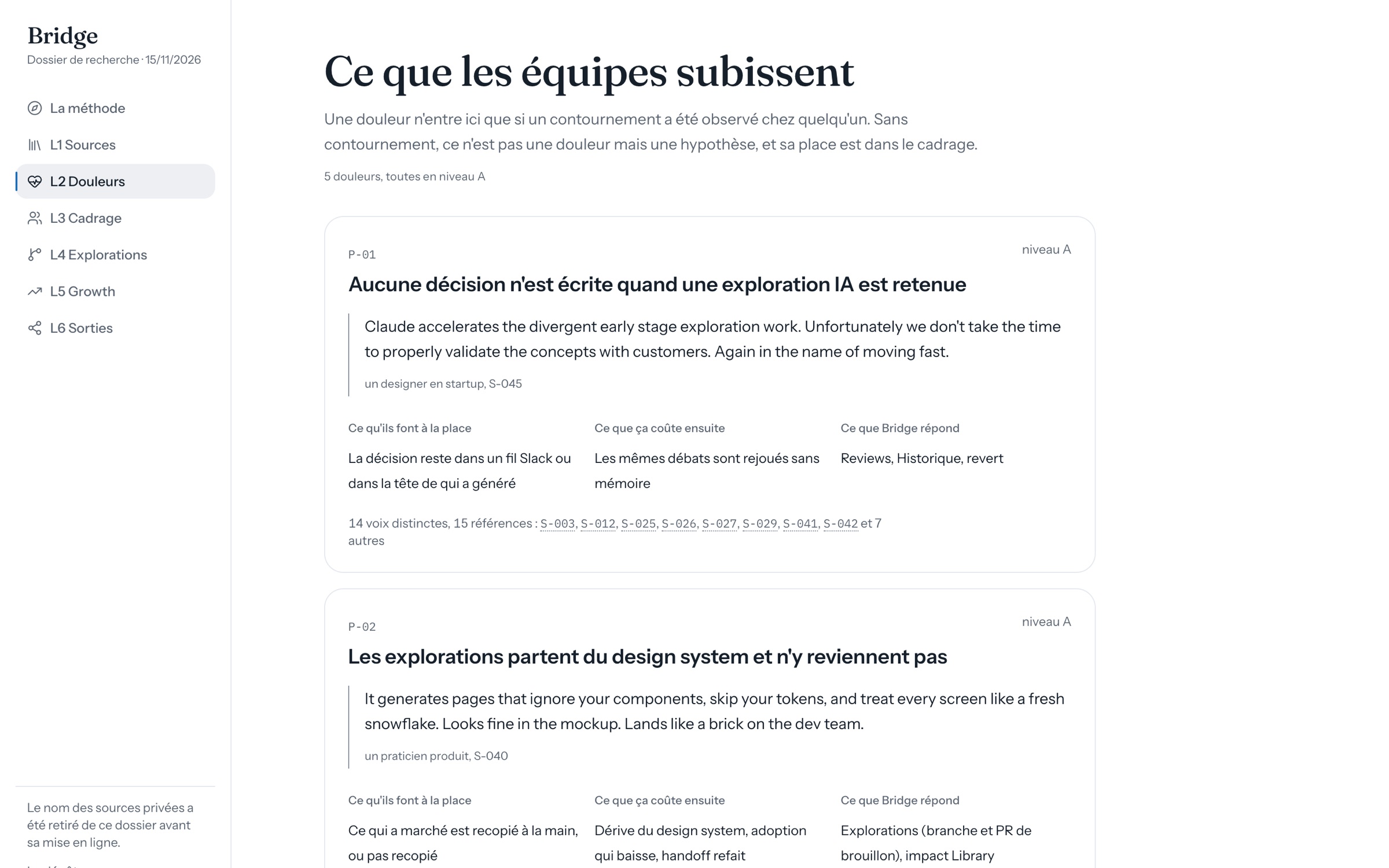
I only kept a pain when I could show the workaround people had already built for it. A workaround proves the pain is real and that it costs something, because somebody is already paying to route around it.
| Pain | What teams do instead | What it costs downstream | Sources |
|---|---|---|---|
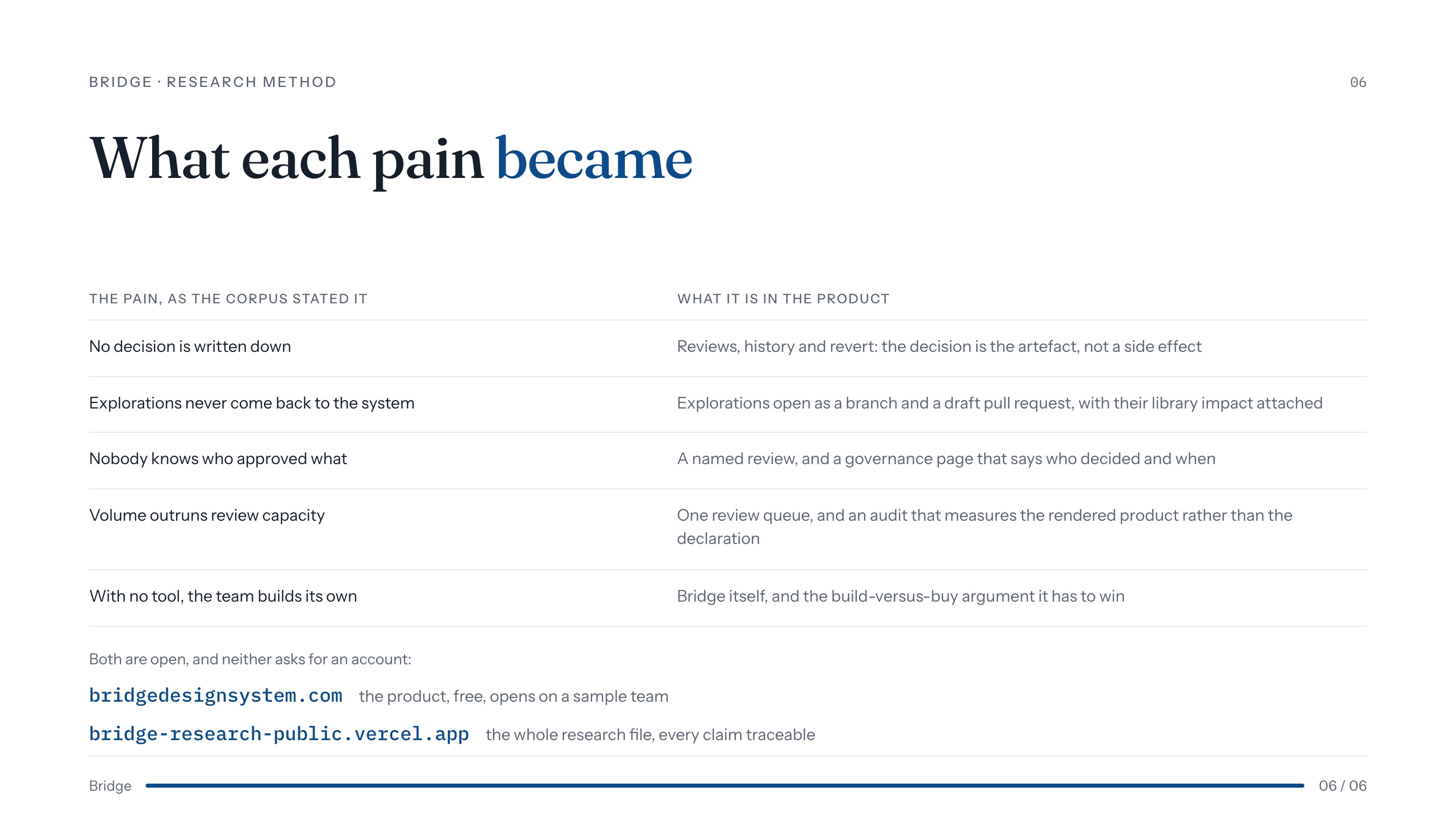
| No decision is written down when an AI exploration is kept | The decision stays in a Slack thread, or in the head of whoever generated it | The same debates get replayed with no memory | 15 |
| Explorations start from the design system and never come back to it | What worked is copied by hand, or not copied at all | System drift, falling adoption, handoff done twice | 31 |
| Nobody knows who approved what | Ask the lead again, or just assume | Blurred responsibility at the moment of the bug | 17 |
| The volume generated outruns human review capacity | Skim the review, or merge without reading | Review debt, repaid in production | 15 |
| With no tool, the team builds its own | An internal tool at an online betting operator, a hand built automation workflow at a car manufacturer, a design system written in markdown | Maintaining a tool that is not their product | 4 |
The last one has the fewest sources and mattered the most. Four teams had each decided it was cheaper to build their own governance tool than to keep working without one. That is the strongest buying signal in the corpus, and the clearest statement of what the product had to beat.
🔄 What the corpus contradicted
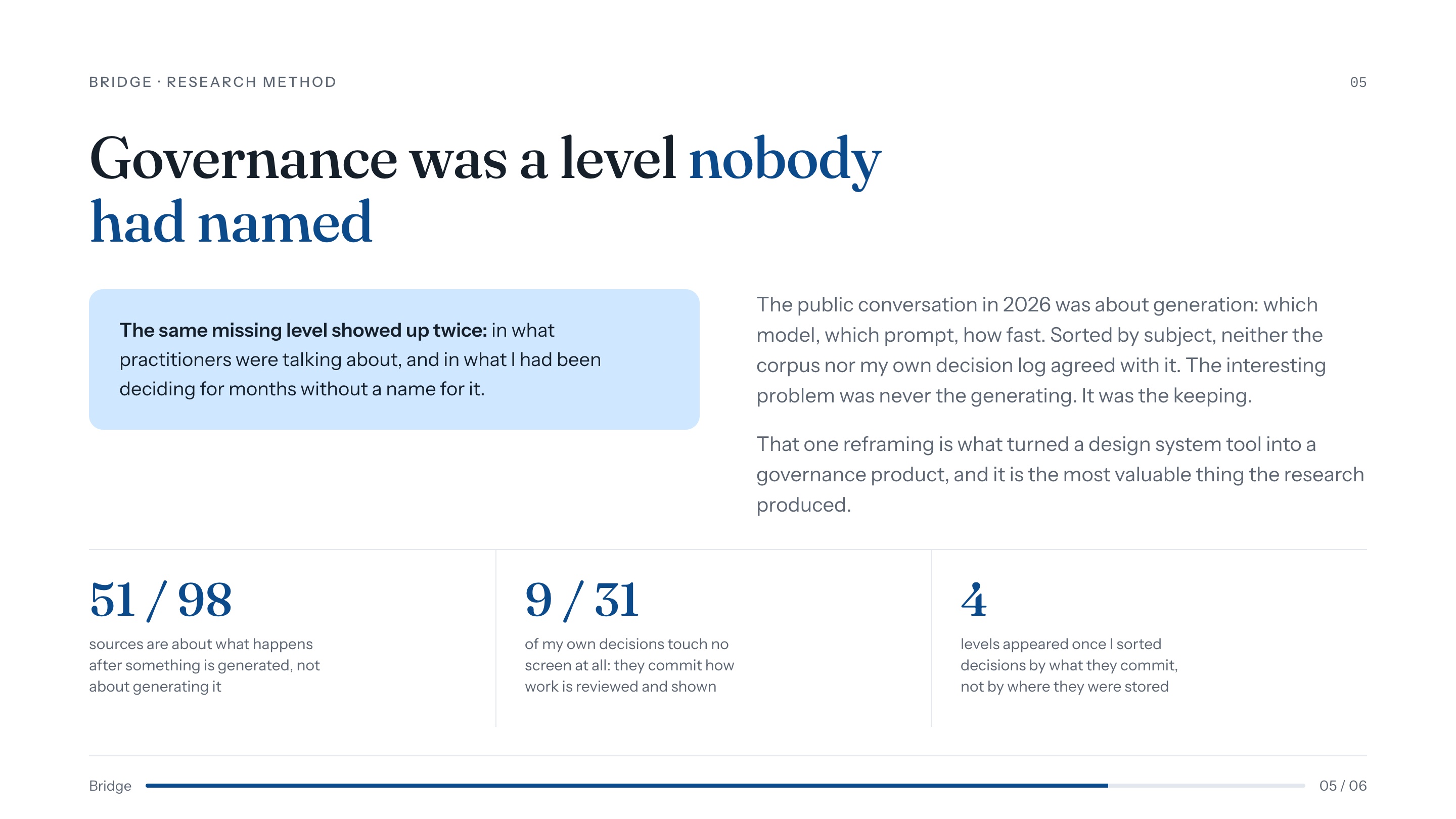
The public conversation in 2026 was about generation: which model, which prompt, how fast. My corpus was not. Sorted by subject, 47 of the 81 sources are about what happens after something is generated: 30 on the governance of explorations, 17 on design system adoption. Eleven are about new ways of working with AI at all.
So the interesting problem was never the generating. It was the keeping. That reframing is what turned a design system tool into a governance product, and it is the most valuable thing the research produced.
🧭 Governance turned out to be a level nobody had named
I had been sorting my own decisions into three buckets by where they were stored, which classified nothing. Re-read against what each one actually commits, four levels appeared:
| Level | Decisions | What it commits |
|---|---|---|
| Product | 14 | What a person sees and can do |
| Governance | 9 | How the work gets done, reviewed and shown. Nothing about the product |
| Strategy | 7 | What the product is, who it is for, what we will not build |
| Technical | 1 | Implementation, reversible |
Nine of thirty one decisions touch no screen at all. They are about how work is reviewed and made visible, which is exactly the category Bridge sells. The taxonomy I needed to understand my own project turned out to be the product's own subject matter.
🗂️ 65 closed explorations, every one with a written reason
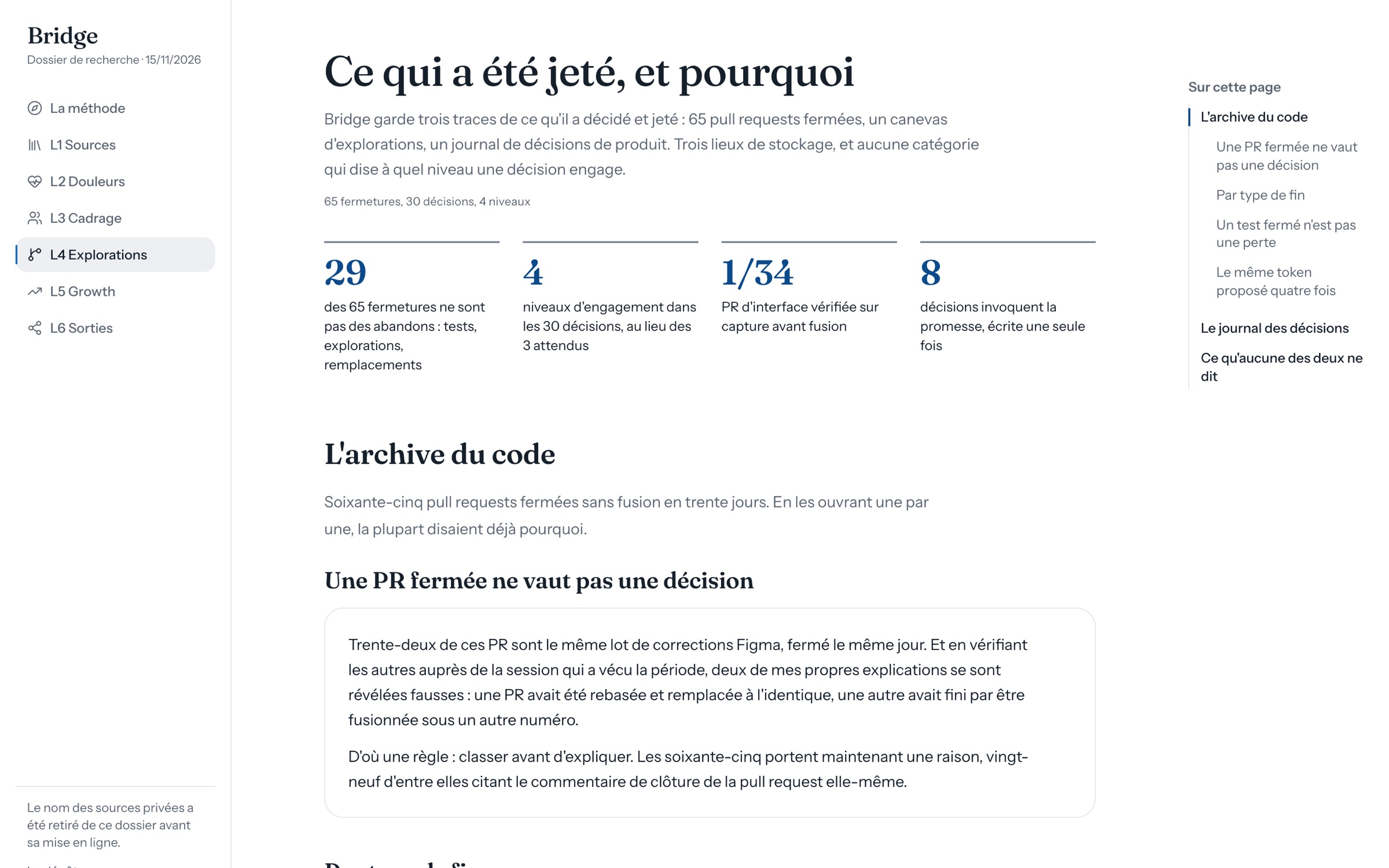
Bridge is built by AI agents working on branches, and every exploration ends in a closed pull request. I read all 65 and recorded why each one closed. Not one is missing a reason.
| Outcome | Count |
|---|---|
| Abandoned and archived | 36 |
| A test, closed on purpose | 11 |
| Ran its course | 9 |
| Superseded by another | 8 |
| Closed by mistake | 1 |
Twenty nine of the 65 are not abandonments. Reading a closed pull request as a failure is the default, and it is wrong more than two times in five. Thirty one of the 65 were opened on a single day, as one batch decision rather than thirty one judgements, which is the kind of thing an archive hides until you count.
📐 The design system it runs on
Bridge runs on its own design system, around thirty components, and its interface uses only real components from it. No hand made imitations: an audit that counts an imitation as adoption is a governance tool lying about governance.
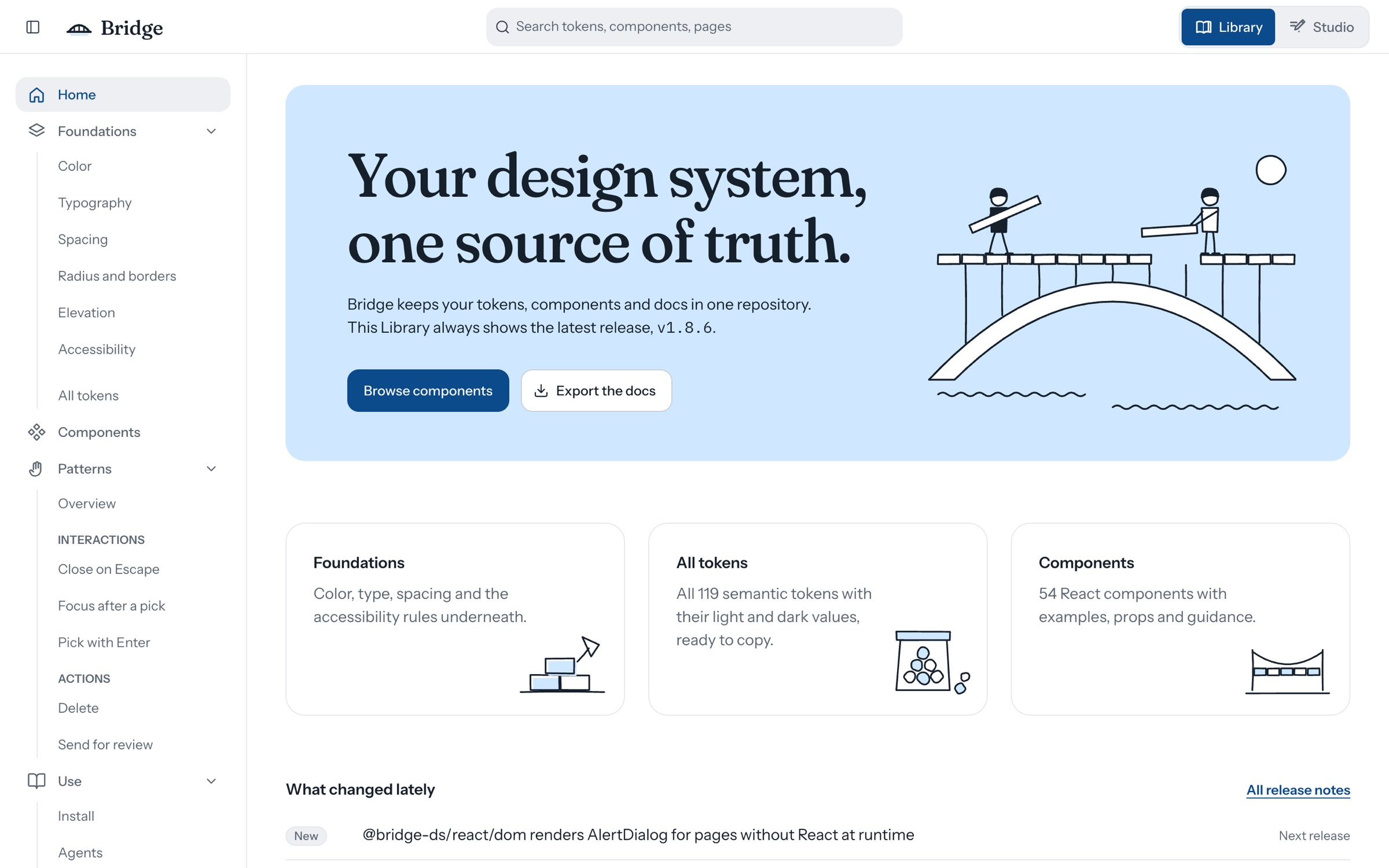
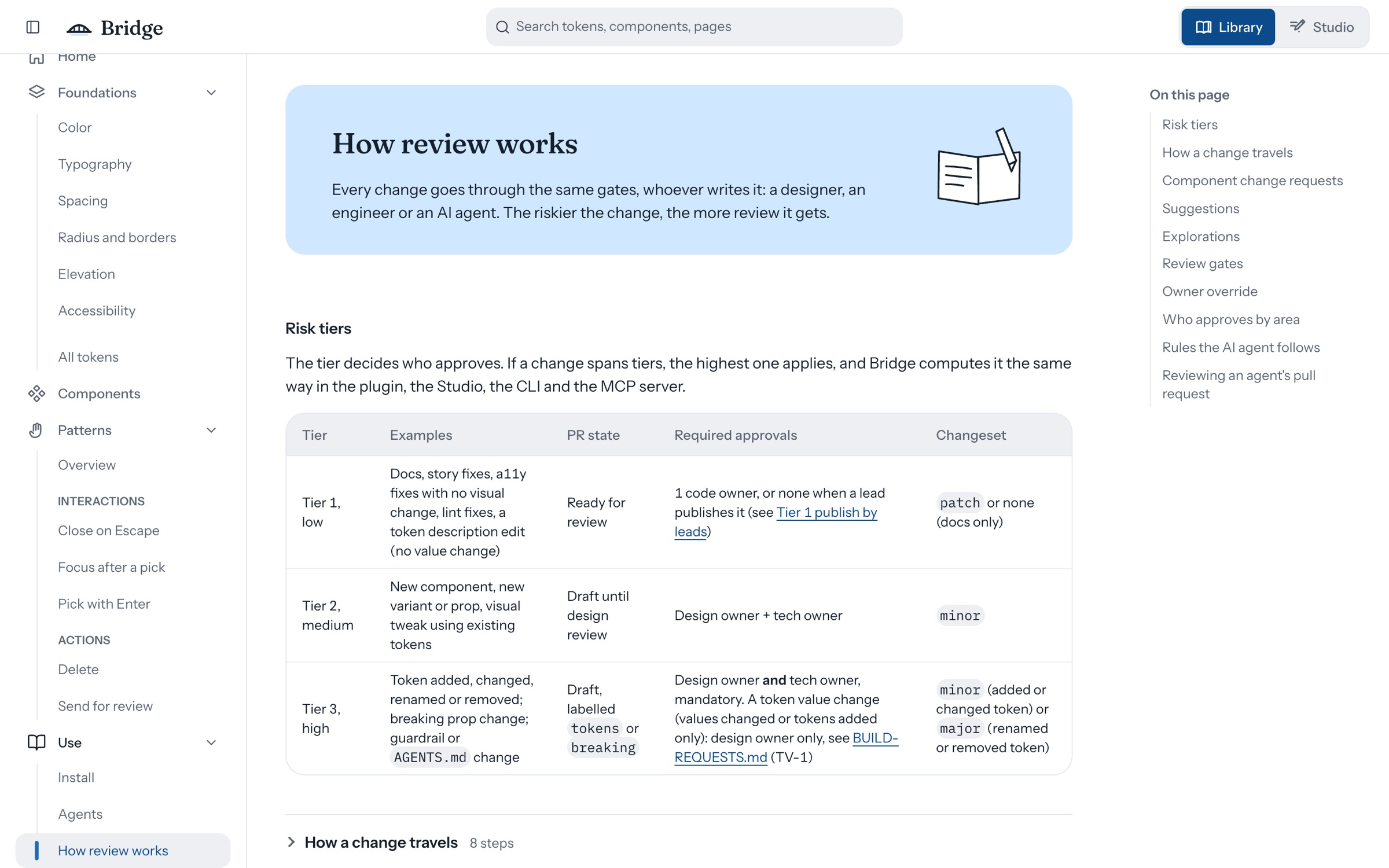
The rule I held to throughout, and the one the corpus agreed on unanimously: never take a capability away from someone already using it.
Key Result
The product is live at bridgedesignsystem.com, free to use and public on GitHub, with components and tokens under MIT and the product under a licence that turns each version MIT after two years.
The research is published in full and reads on its own: the Bridge research file, 81 sources, the five pains, the 65 explorations and the 31 decisions, each traceable to where it came from.