← Back to works

🏦 Cardplayer - Website Redesign for a flagship poker media brand

CardPlayer
Product DesignProduct StrategySEO Product ArchitectureDesign SystemsGrowth Design
📌
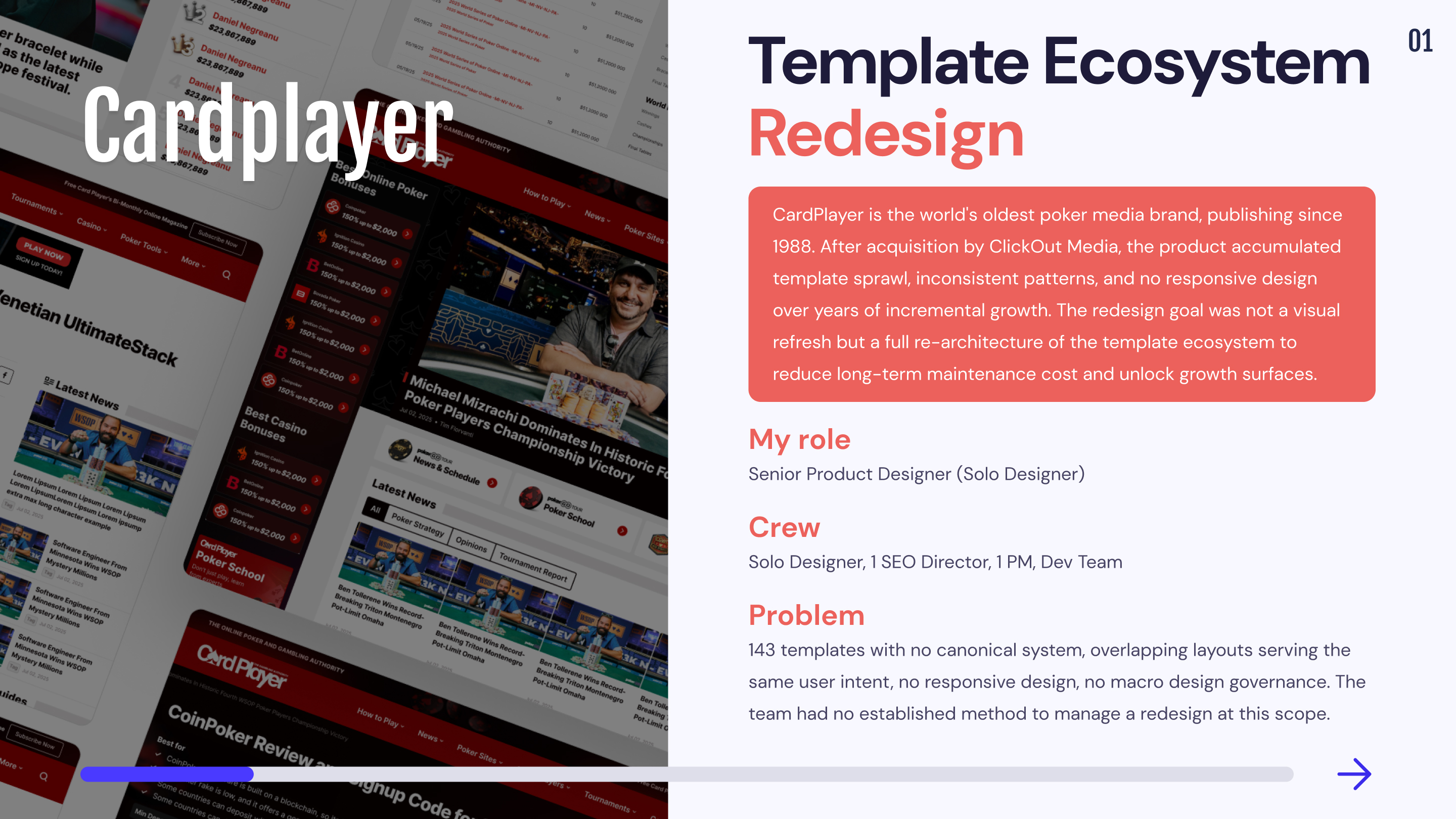
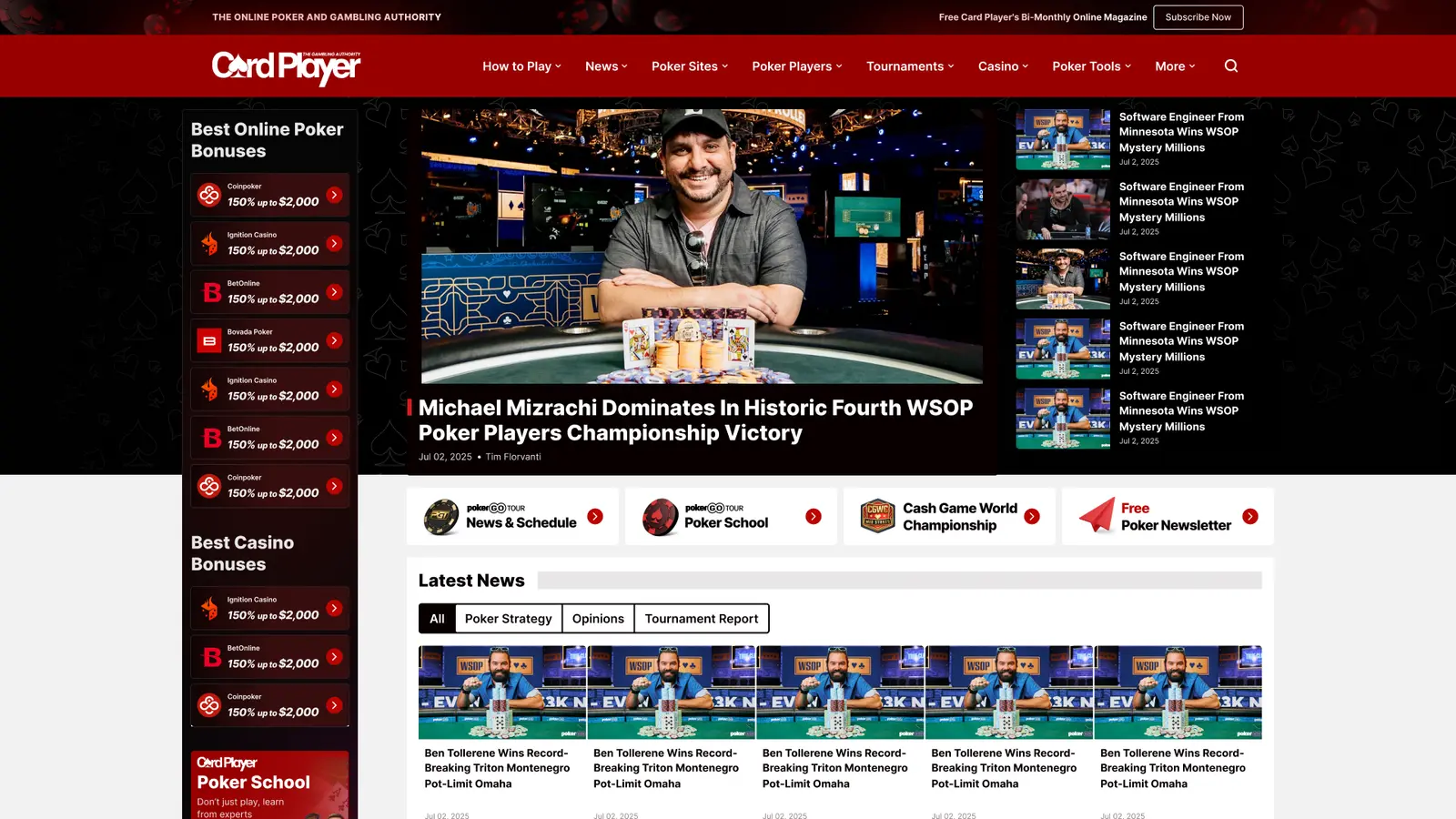
CardPlayer is ClickOut Media’s flagship poker media brand, built on decades of authority. Publishing since 1988, it’s widely recognized as the world’s oldest poker magazine and online guide, carrying strong trust and SEO equity. After its acquisition by ClickOut Media, CardPlayer became a core commercial asset in a broader poker/iGaming portfolio. Its performance depends on organic search, editorial velocity, and affiliate monetization, making template scalability and content structure directly tied to revenue.

Over years of incremental growth, the product accumulated template sprawl, inconsistent patterns, and weak desktop mobile parity, increasing design debt and making further iteration costly. The redesign goal was to re-architect the template ecosystem, not to ship a visual refresh.

⏱️
ContractProject

5 months
🧑‍💻
ductTeam
Solo Designer, Solo designer, 1 Seo Director, 1 PM, Dev Team
🌐
Product
Poker Media Website
Objectives

Modernize CardPlayer’s legacy experience into a scalable, contemporary template system by consolidating repetitive layouts into canonical patterns, improving editorial hierarchy and scanability, restoring desktop mobile parity, strengthening brand authority and trust signals without diluting its DNA, and increasing delivery efficiency through clearer governance and implementation-ready structure.

📬
The missions
  • Audit and map the template ecosystem
  • Define reuse vs rework rules
  • Consolidate archives and listings into canonical patterns
  • Standardize hierarchy, spacing rhythm, and reusable blocks across core templates
  • Set responsive rules
  • Provide macro progress tracking for stakeholders
  • 🌎
    Work setup

    Remote from Bangkok (GMT+7) with structured async handoff across EU timezone. Operational overlap with Singapore, Sydney, and Tokyo without schedule constraint.

    Mission 1: System diagnosis and Scope control
    📒
    Context

    The product had become a patchwork of templates added over years to ship fast. The outcome was predictable: the same user intent served by multiple layouts, unclear rules, inconsistent navigation across sections, and endless debates because no one had a system view. The real risk wasn’t “bad UI”, it was an unfinishable redesign.

    CardPlayer’s redesign was a large template migration with multiple stakeholders and hard business constraints. At this scale, the main risk isn’t UI quality, it’s execution failure: unclear scope, inconsistent implementation, and the system decaying back into new one-off variants. Jira covered micro delivery, but it didn’t provide macro visibility on progress, priorities, dependencies, or remaining scope. In parallel, the design system risked becoming too heavy to maintain if component variants exploded in Figma.

    🎯
    My daily tasks
  • Audited the experience as a system: intents, page families, recurring patterns, and high-impact inconsistencies
  • Turned the audit into an executable plan: inventory, prioritization, dependencies, and delivery order
  • Defined a clear decision rule for every request: reuse by default, rework only when IA or navigation hierarchy is broken
  • Aligned Product, SEO, and Engineering on canonical templates and what should not be redesigned
  • Maintained a macro tracking layer (in parallel to Jira) to give stakeholders a clear view of scope, priorities, progress, and blockers
  • 1. Established scope clarity and prioritization


    📔 Context

    The redesign started with a broad “redesign everything” ambition, but the team had no established method to manage a redesign at this scope (no roadmap, no definition of done, no sequencing).

    🚨 Problem

  • No prioritization model -> unclear what to ship first and what could wait
  • Parallelizing everything -> delivery risk and stakeholder confusion
  • 💊 Solution

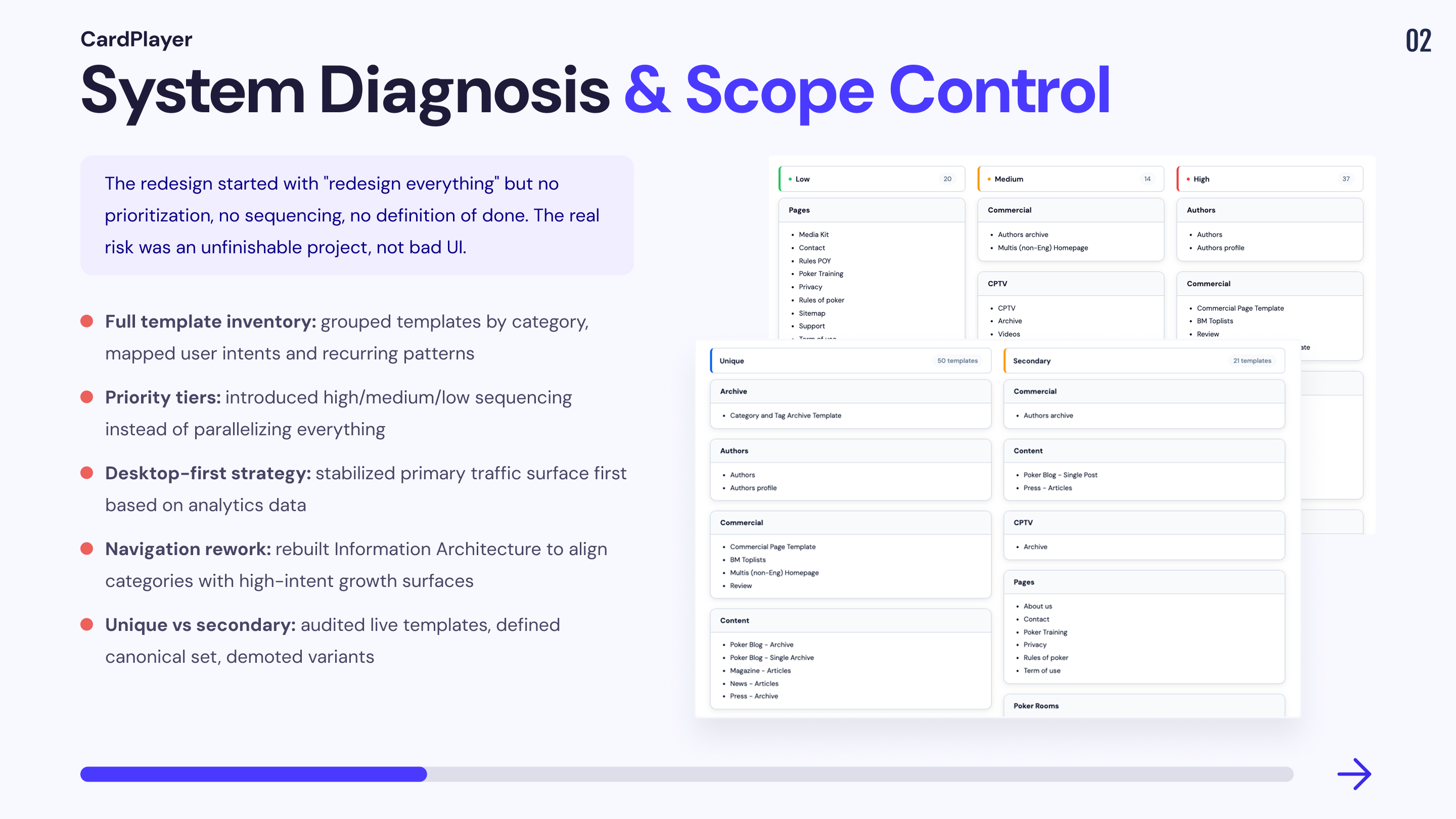
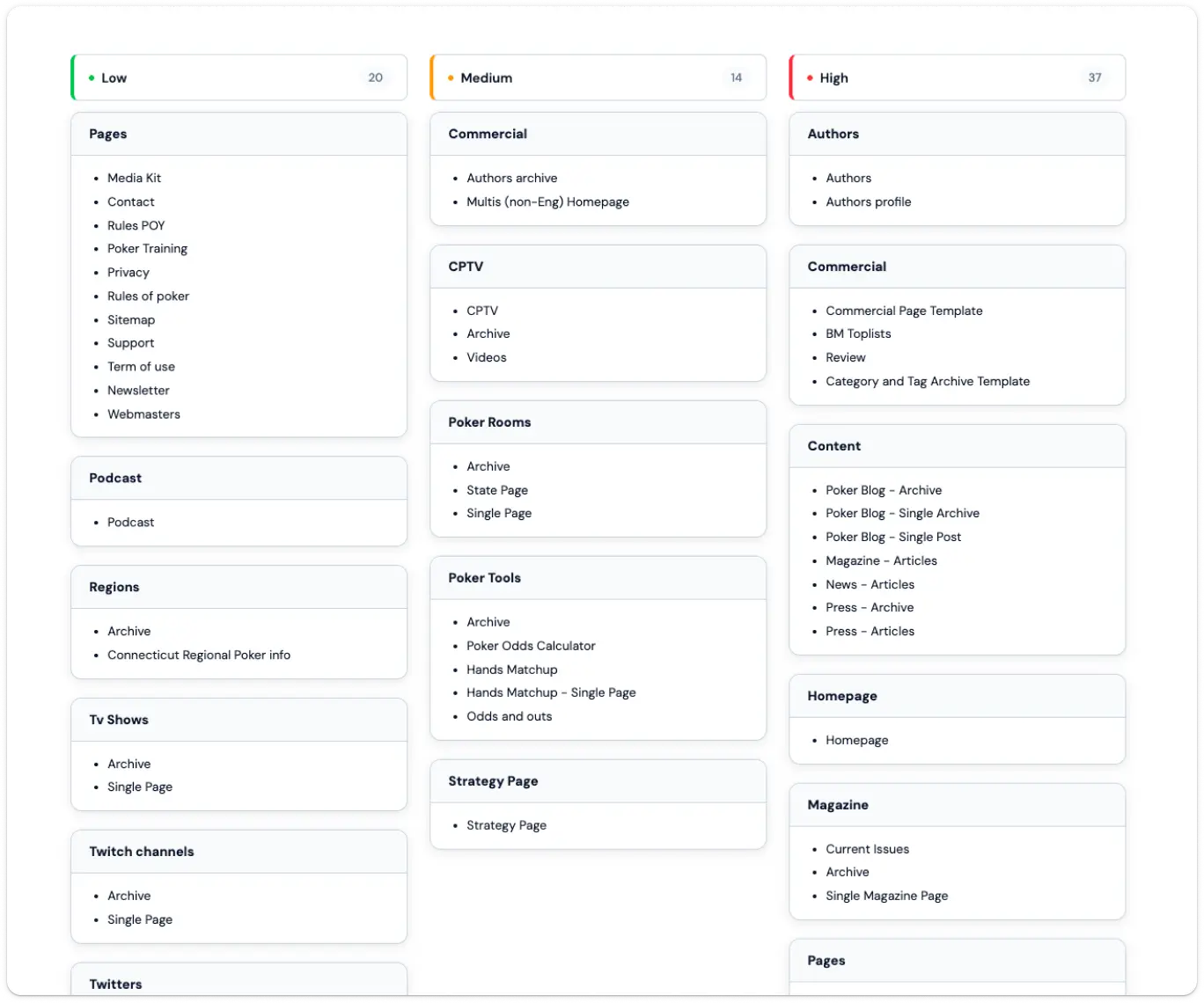
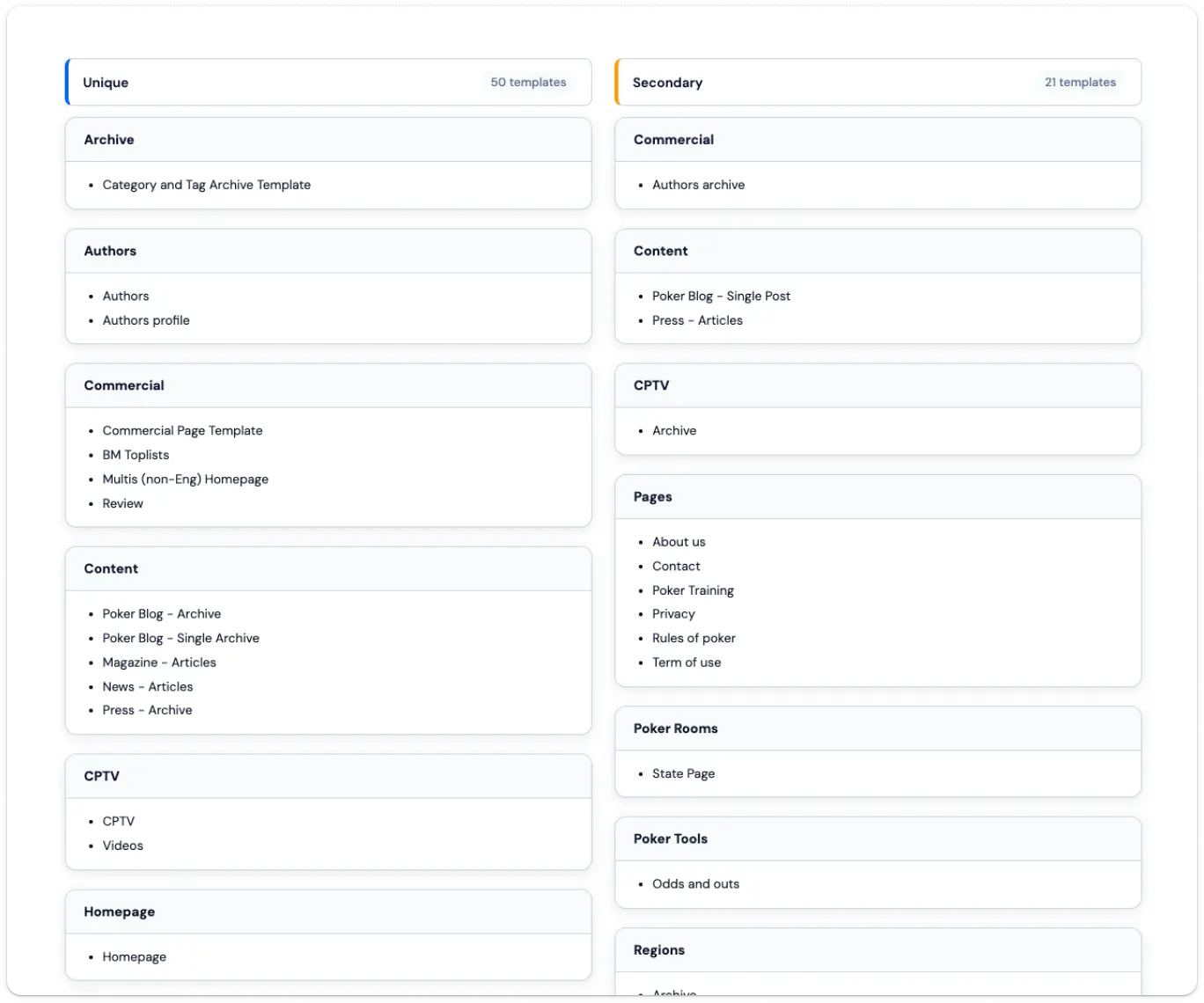
  • Built the first full template inventory -> grouped templates by category (content, magazine, poker rooms etc…)
  • Introduced priority tiers (high/medium/low) -> sequenced delivery instead of redesigning everything at once
  • Defined “what ships” vs “what can wait” -> reduced scope drift and enabled clearer handoff planning
  • 2. Etablished a desktop first strategy


    📔 Context
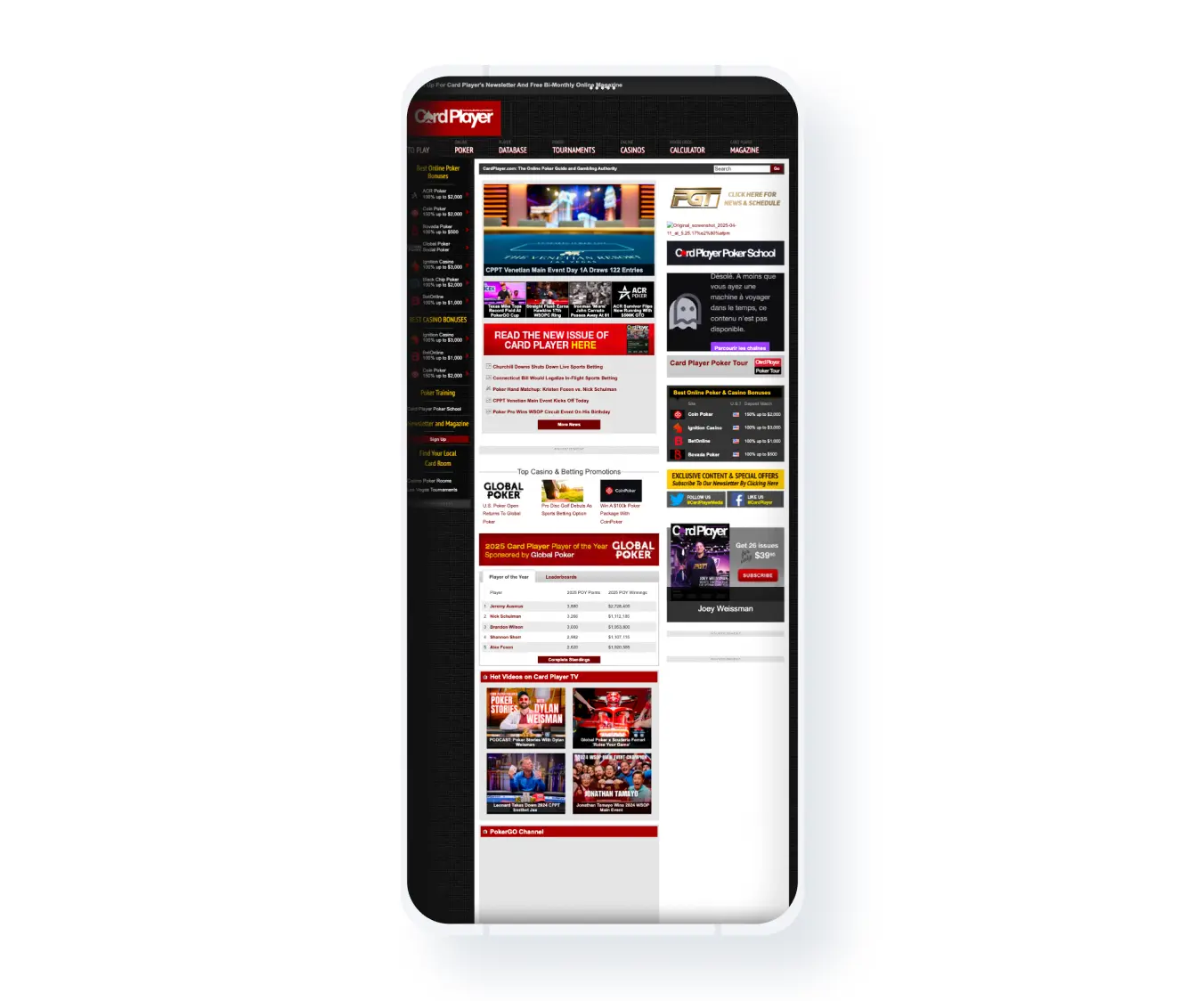
    At project start, the site wasn’t responsive and analytics showed desktop as the primary traffic driver. The business needed the highest-impact surface stabilized first.

    🚨 Problem

  • Designing mobile early would have meant designing on unstable, inconsistent foundations
  • Risk of building two different experiences if parity rules weren’t defined from a stable desktop baseline
  • Scope explosion if desktop and mobile were rebuilt in parallel
  • 💊 Solution

  • Stabilized high-priority desktop templates first to protect the primary traffic surface
  • Started mobile declination only once core desktop patterns were standardized, ensuring mobile was a consistent adaptation of the system rather than a separate redesign
  • Outcome: desktop-first became a data-driven sequencing decision, not a design preference, and reduced parity drift risk later.

    3. Reworked global navigation and content categorization


    📔 Context
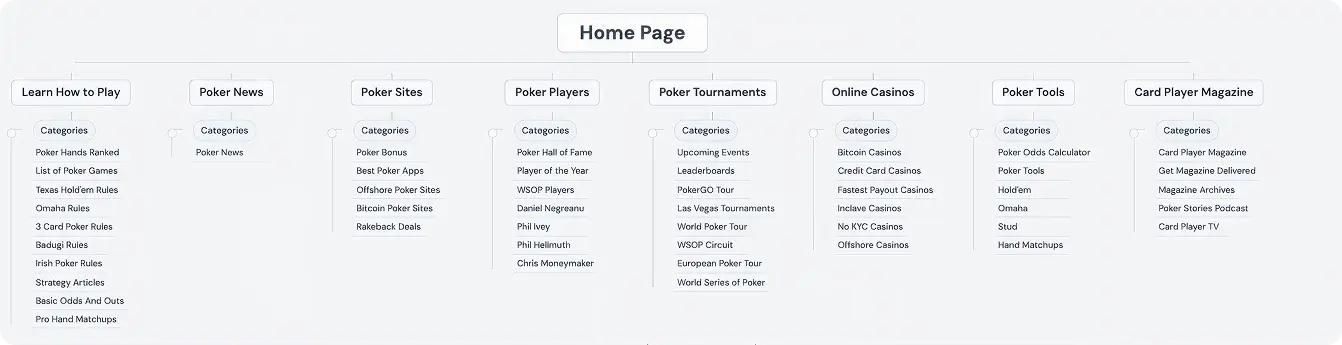
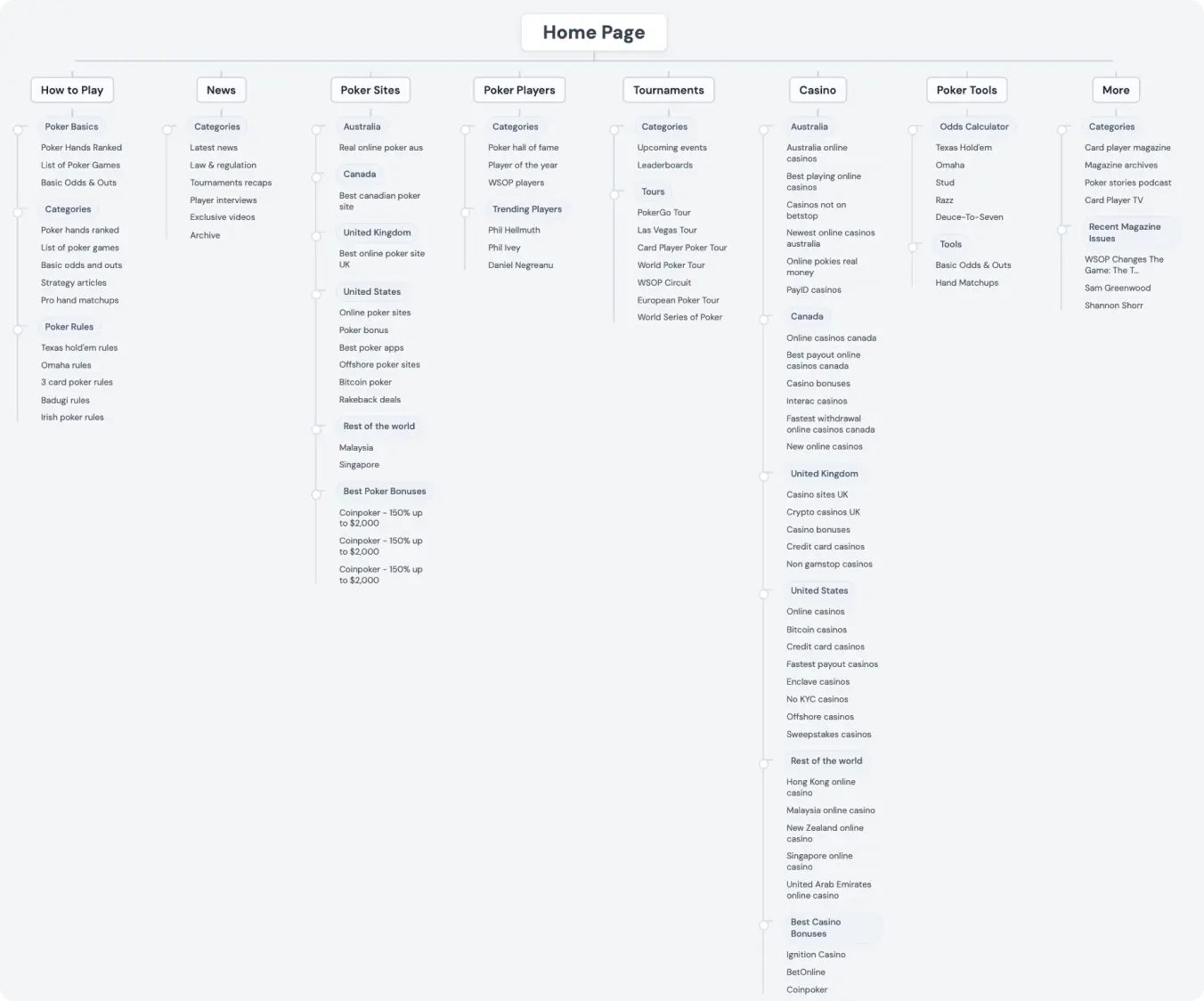
    The existing navigation was built from legacy growth, with overlapping categories and unclear content grouping. For an SEO and affiliate media product, navigation is a growth surface: it drives discovery, internal linking, and revenue routing.

    🚨 Problem

  • Content categories overlapped -> weak orientation and diluted internal linking structure
  • High-intent surfaces (Tools, Guides, key commercial categories) were not surfaced clearly
  • Navigation structure didn’t reflect business priorities (what should drive traffic and monetization)
  • 💊 Solution

  • Rebuilt the information architecture -> simplified and clarified top-level categories
  • Repositioned high-intent sections (Poker Tools, Guides, key commercial pages) to improve discoverability
  • Reduced noise and improved grouping -> clearer user mental model + stronger internal linking foundations for SEO
  • 4. Defined unique vs secondary templates


    📔 Context

    Over time, CardPlayer added new “templates” in a fast-paced environment to ship quickly. Many of these pages were not truly unique products: they were small variations of an existing intent, created without a global view of the ecosystem.

    🚨 Problem

  • Multiple templates delivered the same utility, differing only by minor layout decisions
  • No canonical baseline -> teams kept creating one-off variants instead of reusing patterns
  • Design debt compounded: inconsistency, higher maintenance cost, slower iteration
  • 💊 Solution

  • Audited live templates and grouped them by user intent and content hierarchy to identify what was truly unique vs what was a secondary variation
  • Defined a canonical set of core templates and demoted secondary templates into controlled variants
  • Merged accidental variants back into the canonical system using standardized modules, hierarchy rules, and density constraints
  • 📊
    Measurable Results
  • 100% of template scope mapped and categorized
  • Priority tiers established (high/medium/low) enabling sequenced delivery vs parallel chaos
  • Global navigation re-architected to align Information Architecture with high-intent growth surfaces
  • Mission 2: Canonical layouts and growth levers under monetization constraints
    📒
    Context

    Multiple templates existed for the same user intent across archives and listings, fragmenting UX and multiplying maintenance cost. The goal was to modernize by defaulting to reuse, and reserving rework for cases where IA or navigation hierarchy was objectively inconsistent.

    🎯
    My daily tasks
  • Applied a reuse vs rework decision rule during reviews to stop one-off layouts
  • Designed canonical archive and listing structures and validated reuse across content families
  • Standardized list and card hierarchy, density, and pagination rules to reduce drift
  • Coordinated with PM, SEO, and engineering to confirm what could be consolidated without harming business constraints
  • Documented variation rules so implementation wouldn’t recreate template sprawl
  • 1.Layour Rework : Negotiated monetization constraints without degrading UX


    📔 Context
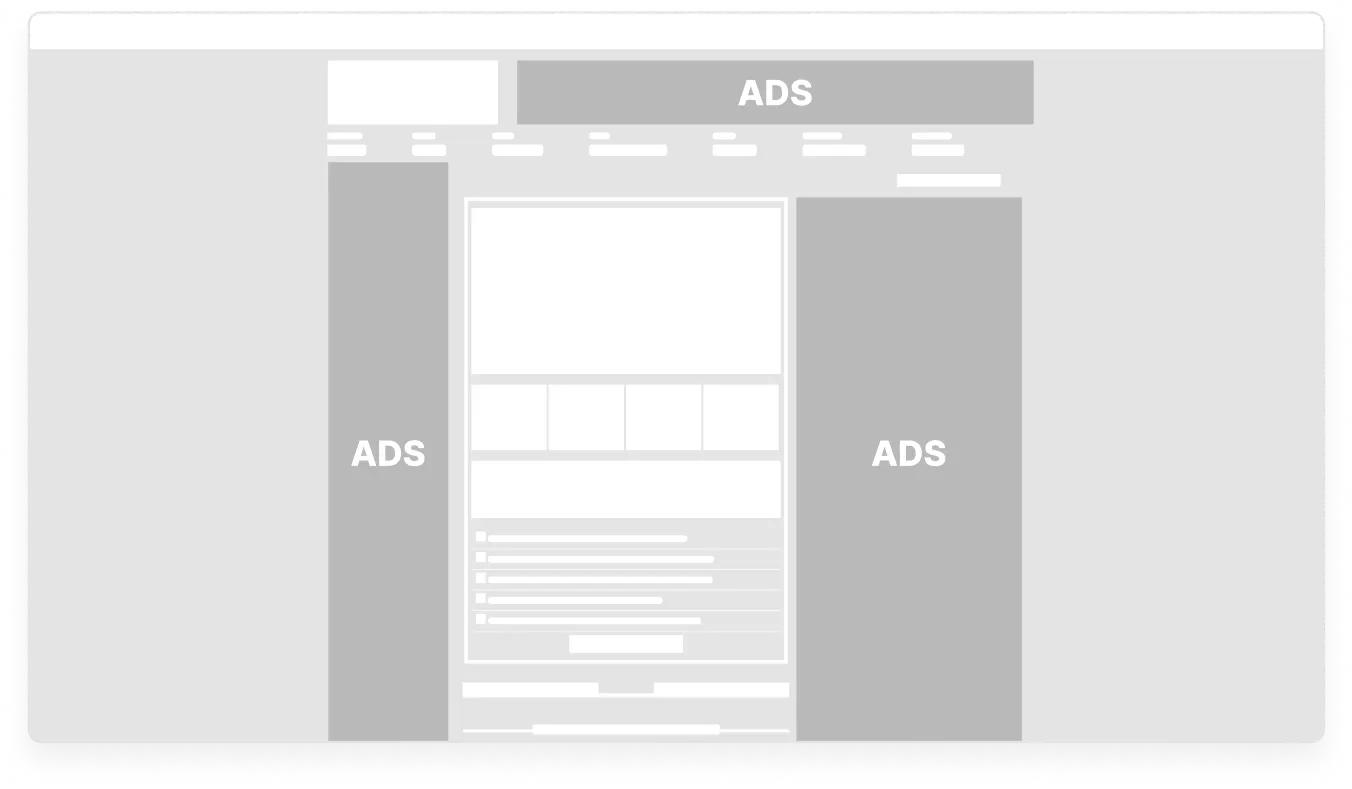
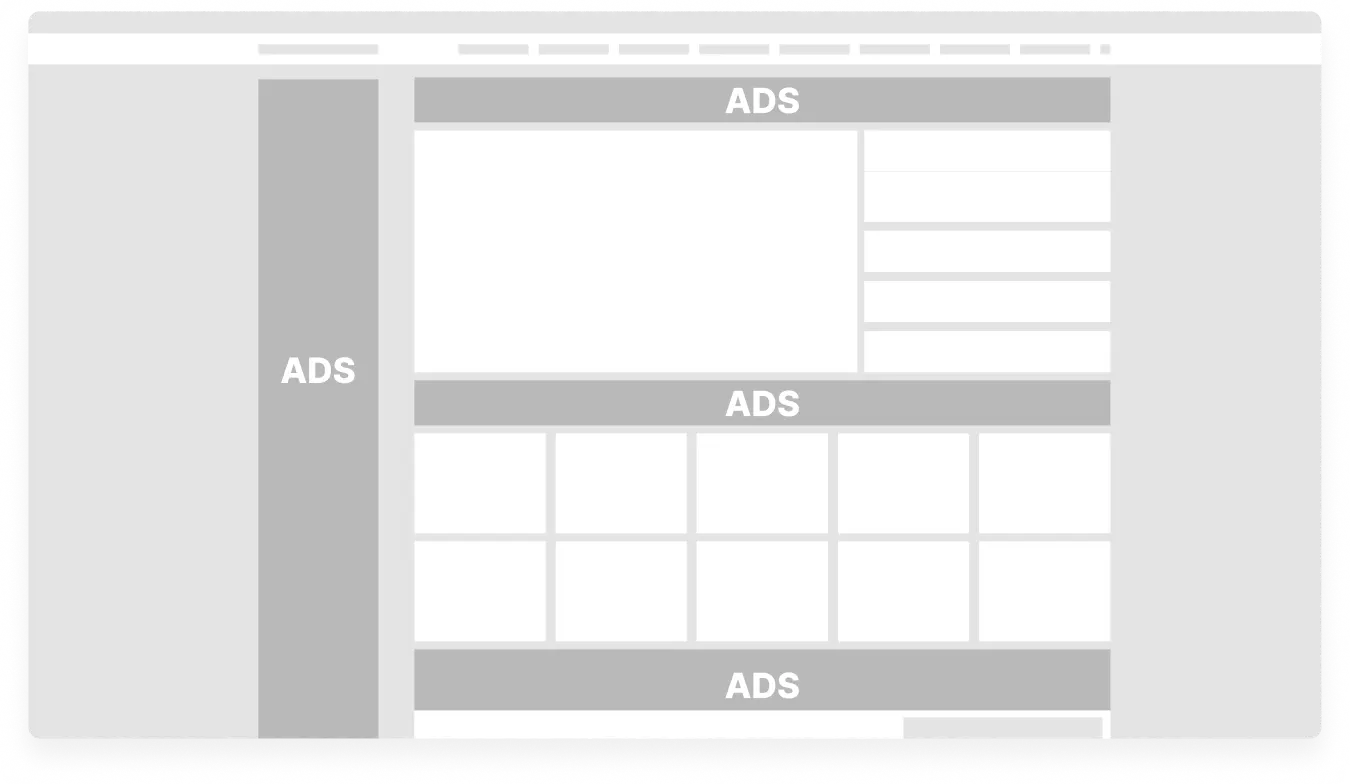
    A major constraint was monetization: ad columns were a core revenue model. But the homepage also needed to perform as a credibility and discovery surface, not just an ad frame.

    🚨 Problem

  • Two ad columns can compress content, reduce readability, and weaken perceived quality
  • Homepage needed to balance monetization with editorial authority and navigation to high-intent sections
  • Stakeholders were initially split between keeping the layout vs revising structure
  • 💊 Solution

  • Negotiated a homepage-specific compromise: reduced right-side ad load to reclaim central content focus
  • Kept a monetization column where it mattered (best bonus / key redirects) while moving secondary items into the content flow
  • Accepted full two-column constraints on other templates where the trade-off was less harmful, preserving revenue mechanics while standardizing layout rules
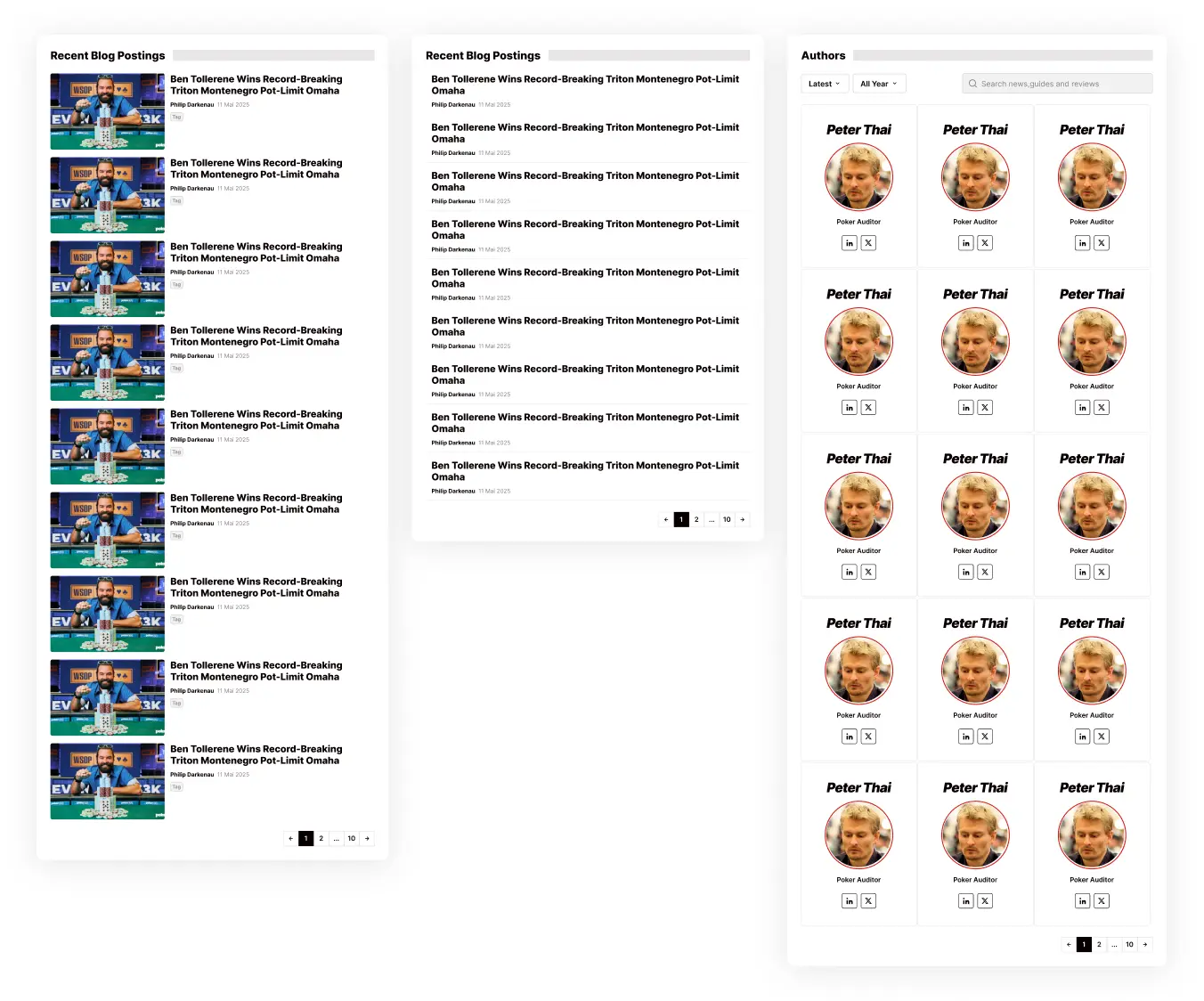
  • 2. Canonical archive/listing system (reduce template sprawl)


    📔 Context
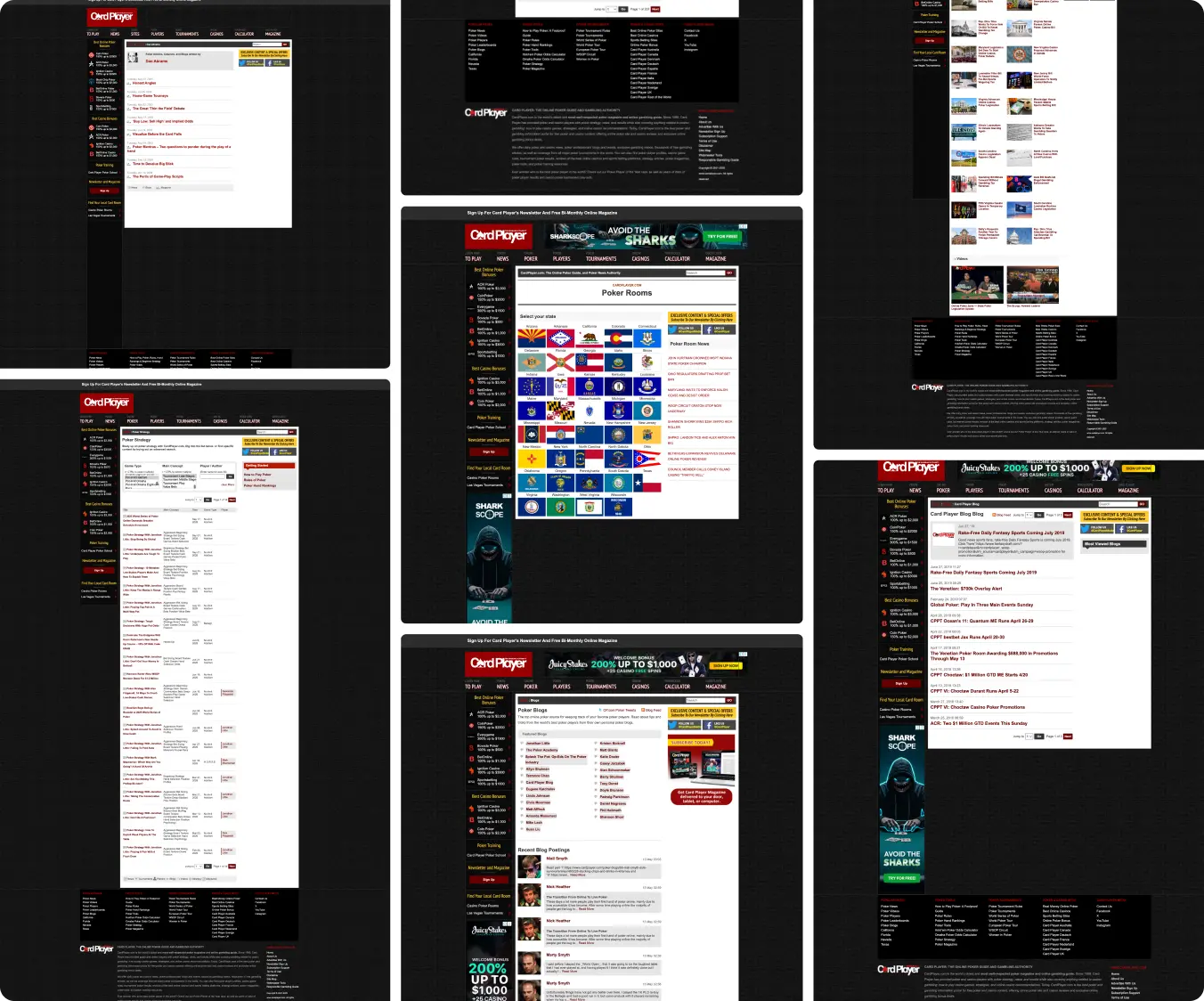
    Archive/list templates represent the largest repeated surface area on SEO-driven media sites and drive a major share of traffic entry points and internal recirculation.

    🚨 Problem

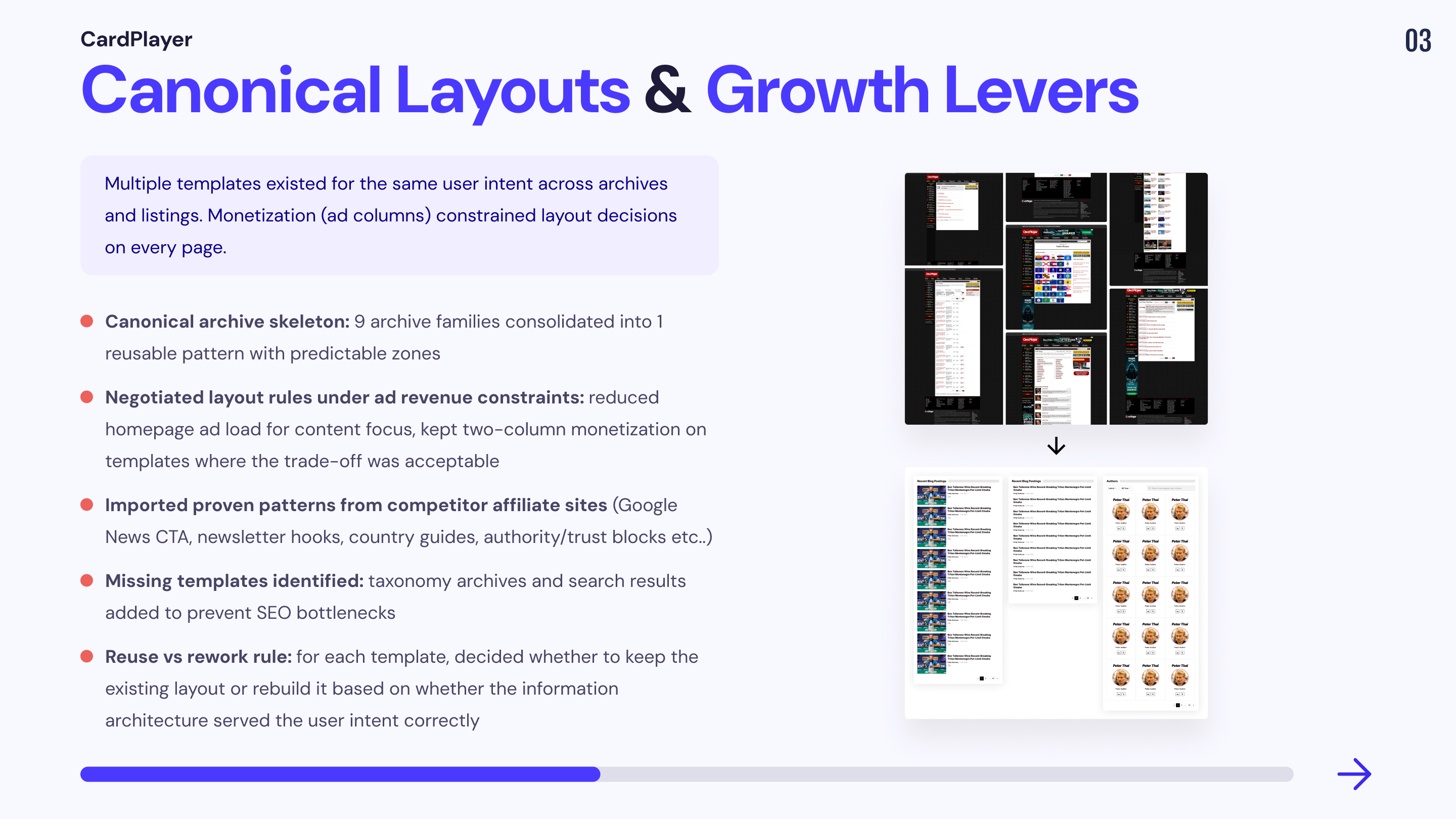
  • “Same intent, different template” across blog/news, press releases, topics, tournaments, authors, poker rooms, regions, CPTV, strategy
  • Inconsistent hierarchy, spacing, and card logic -> fragmented UX and duplicated dev effort
  • Any CRO/UI change required multiple passes across variants
  • 💊 Solution

    Standardized a canonical archive/list skeleton with predictable zones:

  • header/context + authority cues
  • optional sub-navigation
  • filtering/sorting (when relevant)
  • primary list zone
  • pagination/continuity rules
  • 3. Growth opportunities: importing proven affiliate patterns


    📔 Context

    CardPlayer’s redesign wasn’t only about fixing inconsistencies. It needed to compete with modern affiliate poker ecosystems and maximize conversion surfaces already proven across competitor and sister sites.

    🚨 Problem

  • The initial brief missed key templates and growth components that drive SEO and monetization (taxonomy archives, search results, etc.)
  • Under-leveraged authority and trust cues despite CardPlayer’s legacy
  • Homepage and template structures lacked some proven conversion patterns used across competitor affiliate products
  • 💊 Solution

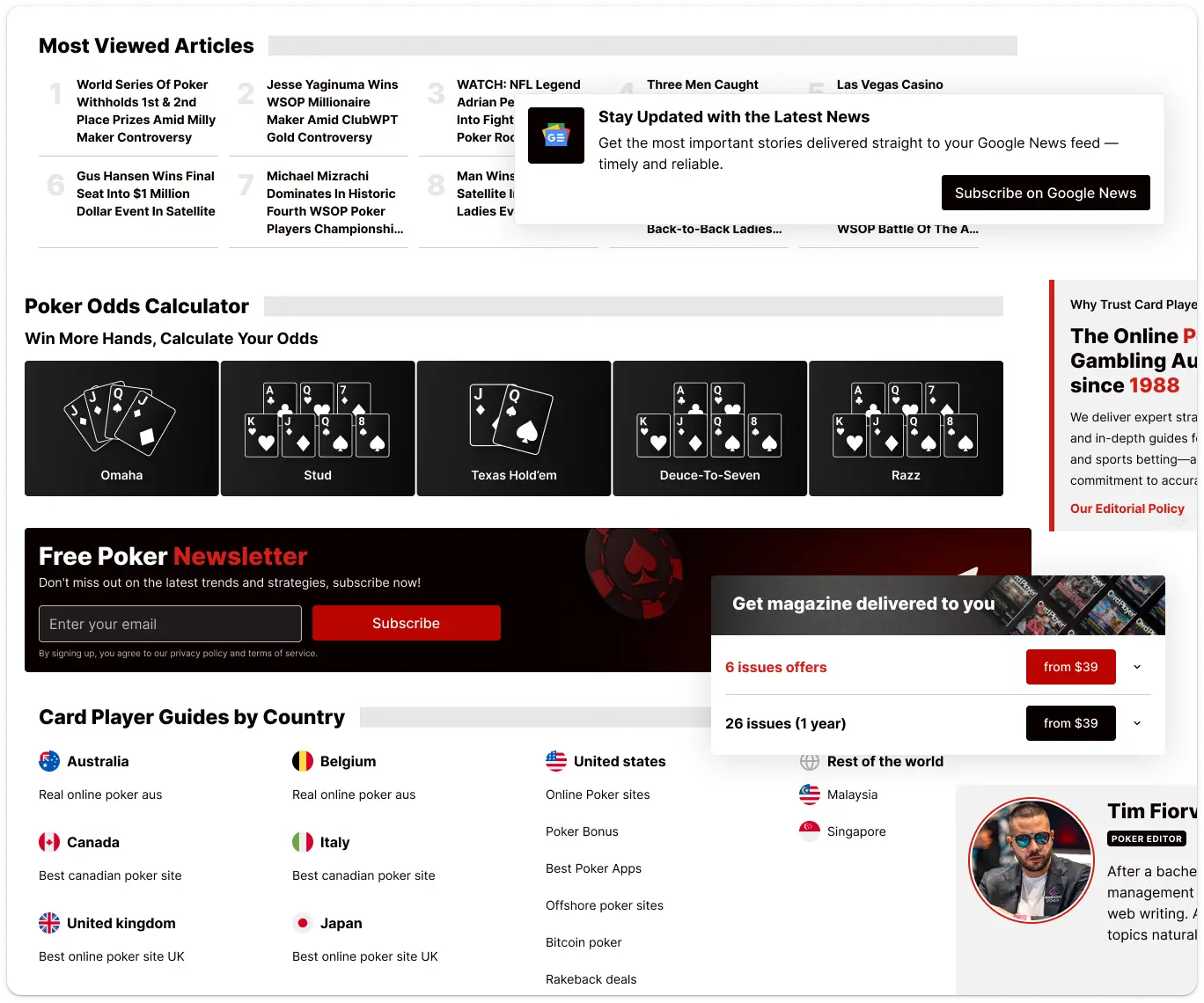
    Imported proven patterns from competitor affiliate sites like:

    📊
    Measurable Results
  • 9 archive families → 1 canonical archive/list skeleton (blog/news, press releases, topics, tournaments, authors, poker rooms, regions, CPTV, strategy)
  • Homepage layout simplified under monetization constraints: reduced right-column ad load to reclaim central content readability while keeping core revenue placements
  • Growth modules added beyond the initial brief: Google News subscribe CTA, newsletter capture placements, country guides/tools surfacing, magazine offer reframing
  • Authority cues systemized: trust blocks standardized with proof points (legacy, social signals, review counts) across high-intent templates
  • Missing templates identified and added to scope: taxonomy archives + search results template to remove SEO/growth bottlenecks
  • Mission 3: Rework key templates to reduce variations and page count
    📒
    Context

    After defining canonical vs secondary templates in Mission 2, it became clear that some “unique” templates were generating disproportionate complexity: layered page variants existed to deliver the same intent, mostly due to legacy fast shipping and lack of global governance. These were not good candidates for controlled variation. The highest leverage move was to rework them into fewer, scalable skeletons, while reusing canonical modules wherever possible. The objective was to reduce template count, collapse variation layers, and improve discoverability and conversion pathways without relying on cosmetic changes.

    🎯
    My daily tasks
  • Used the canonical vs secondary template taxonomy to identify which templates truly deserved a dedicated model vs a modular variation
  • Mapped end-to-end user journeys (Magazine, Tournament, Region, CPTV) to spot where users were forced to bounce between pages to complete one intent
  • Collapsed multi-template flows into single scalable skeletons with modular sections (less branching, clearer rules)
  • Designed hub-level navigation structures (pillars/tabs/dropdowns) to improve discoverability and reduce variation layers
  • Reused canonical archive/list patterns inside reworked templates to avoid creating new one-off systems
  • Standardized core conversion modules (read online, download PDF, print subscription, key entry points) so monetization pathways stayed consistent
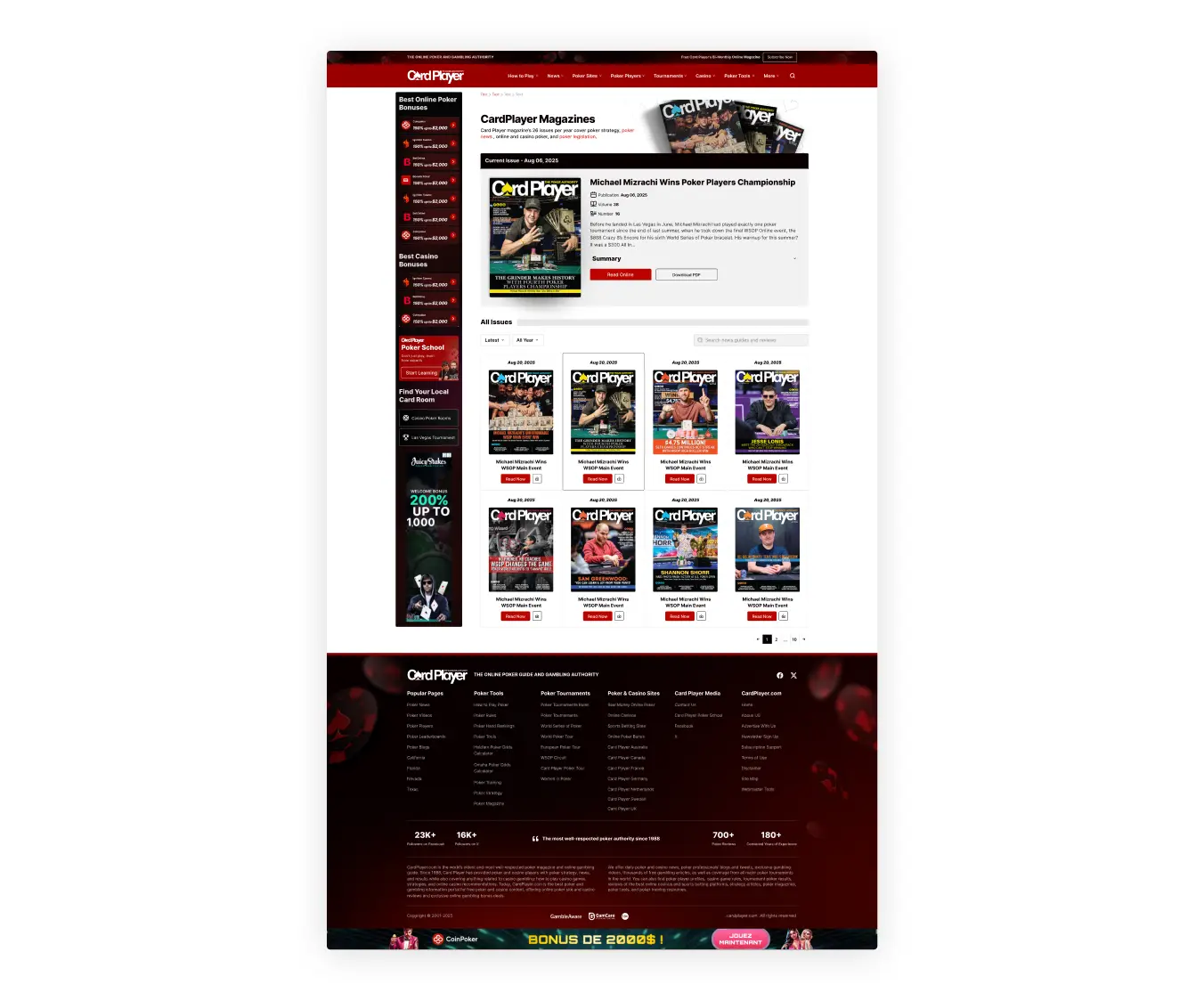
  • 1. Magazine template rework

    📔 Context

    CardPlayer’s magazine experience supports a single user journey: discover issues, find a specific issue, then select it to view a summary (chapters) before reading online or downloading the PDF. The paid conversion lever is print delivery subscription, so the flow needs to be smooth and credibility-driven.
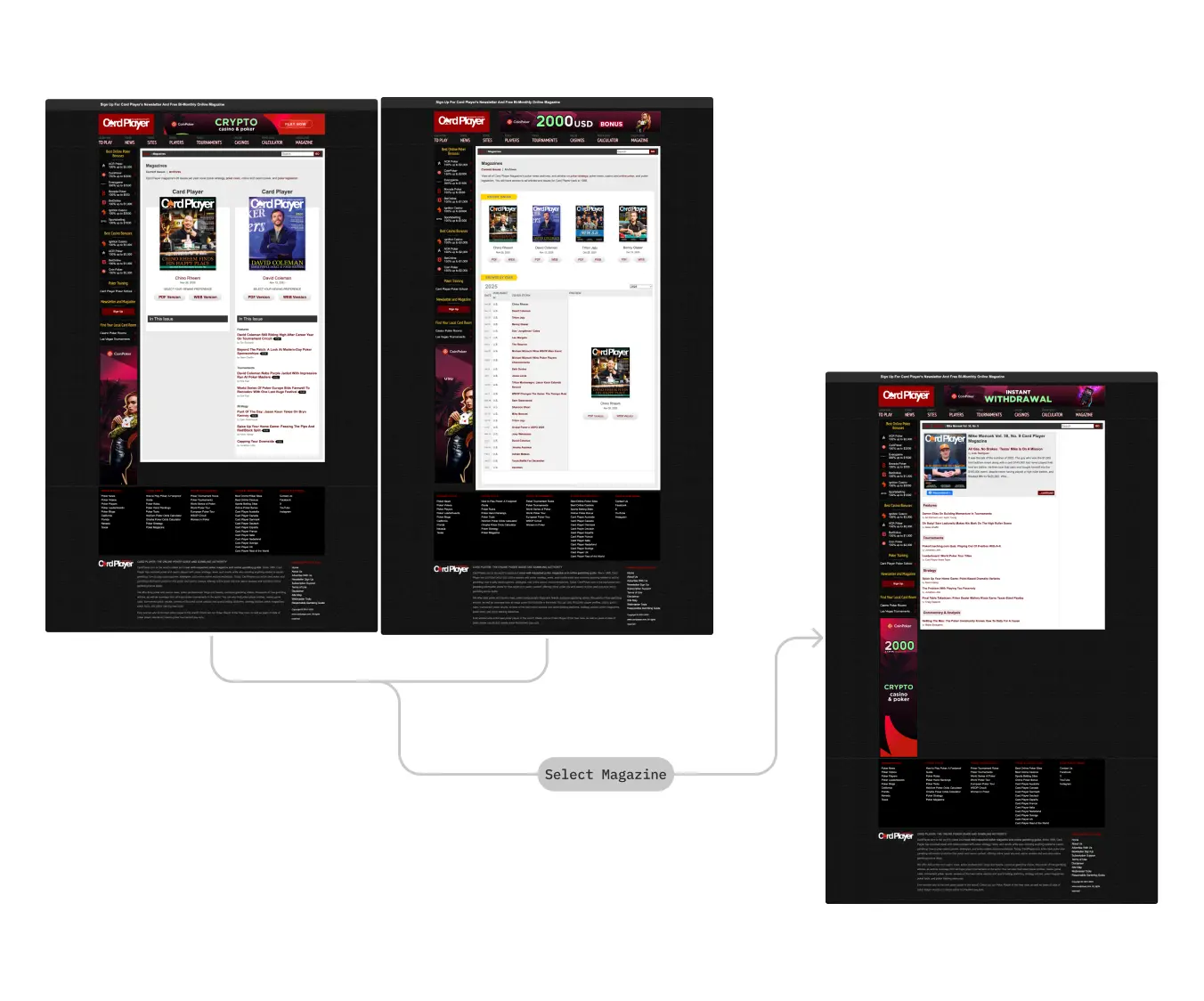
    ℹ️ Latest issues and issue search lived in separate templates, with a third page for issue summary.

    🚨 Problem

  • The journey was split across 2 different discovery templates (latest issues vs search/browse) plus a separate issue summary page, adding friction for one intent
  • Users had to switch pages just to move from discovery to selection to understanding what’s inside
  • Fragmentation increased variation layers, maintenance cost, and inconsistent UX patterns across the same flow
  • 💊 Solution

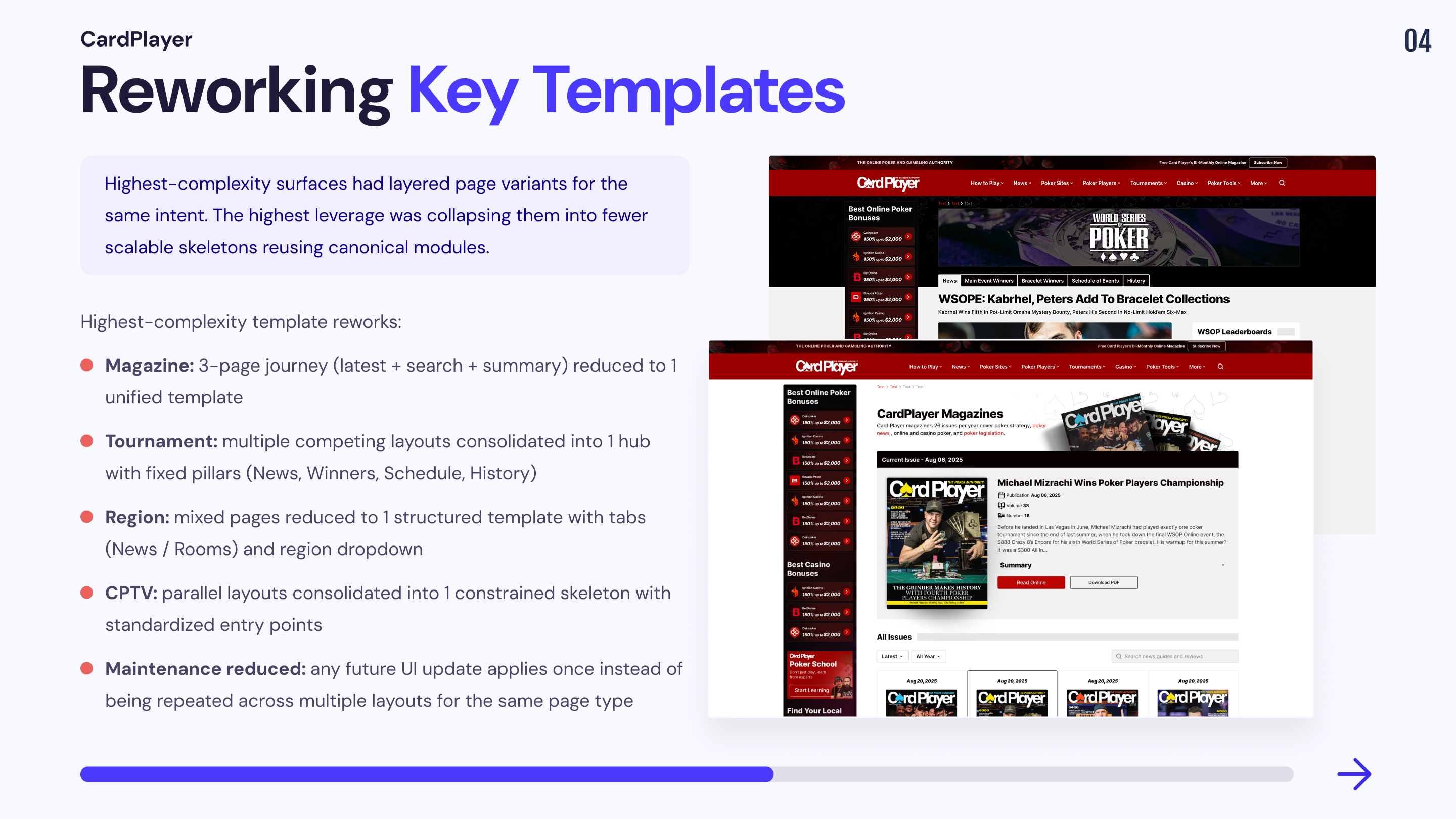
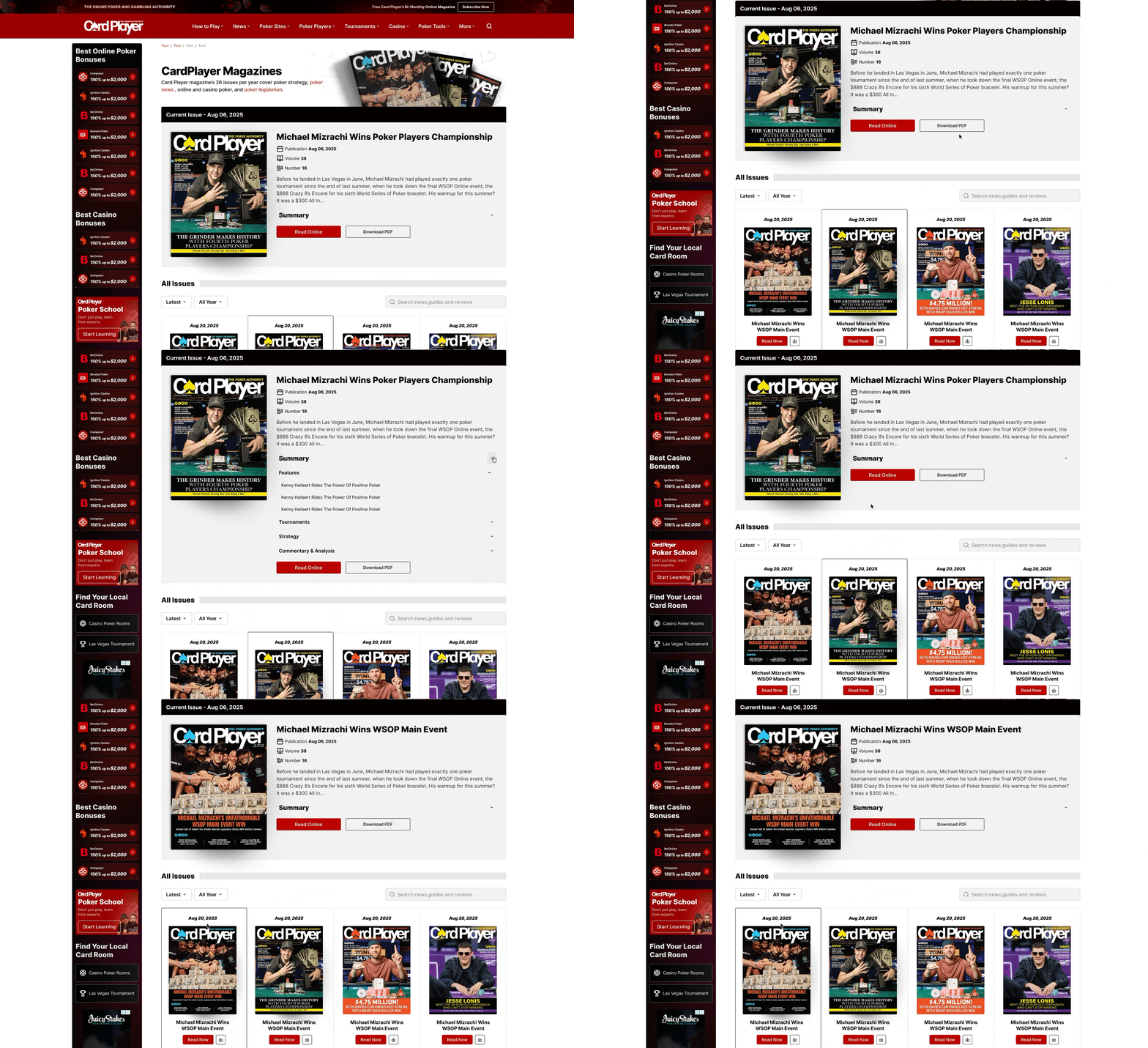
  • Replaced the multi-template flow with one unified Magazine template that supports: latest issues, search/browse, and issue summary (chapters) in a single place
  • Optimized the selection UX by making the issue preview/summary immediate, reducing unnecessary navigation steps
  • Standardized the core actions (read online, download PDF, subscribe to print delivery) as consistent modules within the same template system
  • Reduced page/variant proliferation by standardizing how issues and related content are surfaced
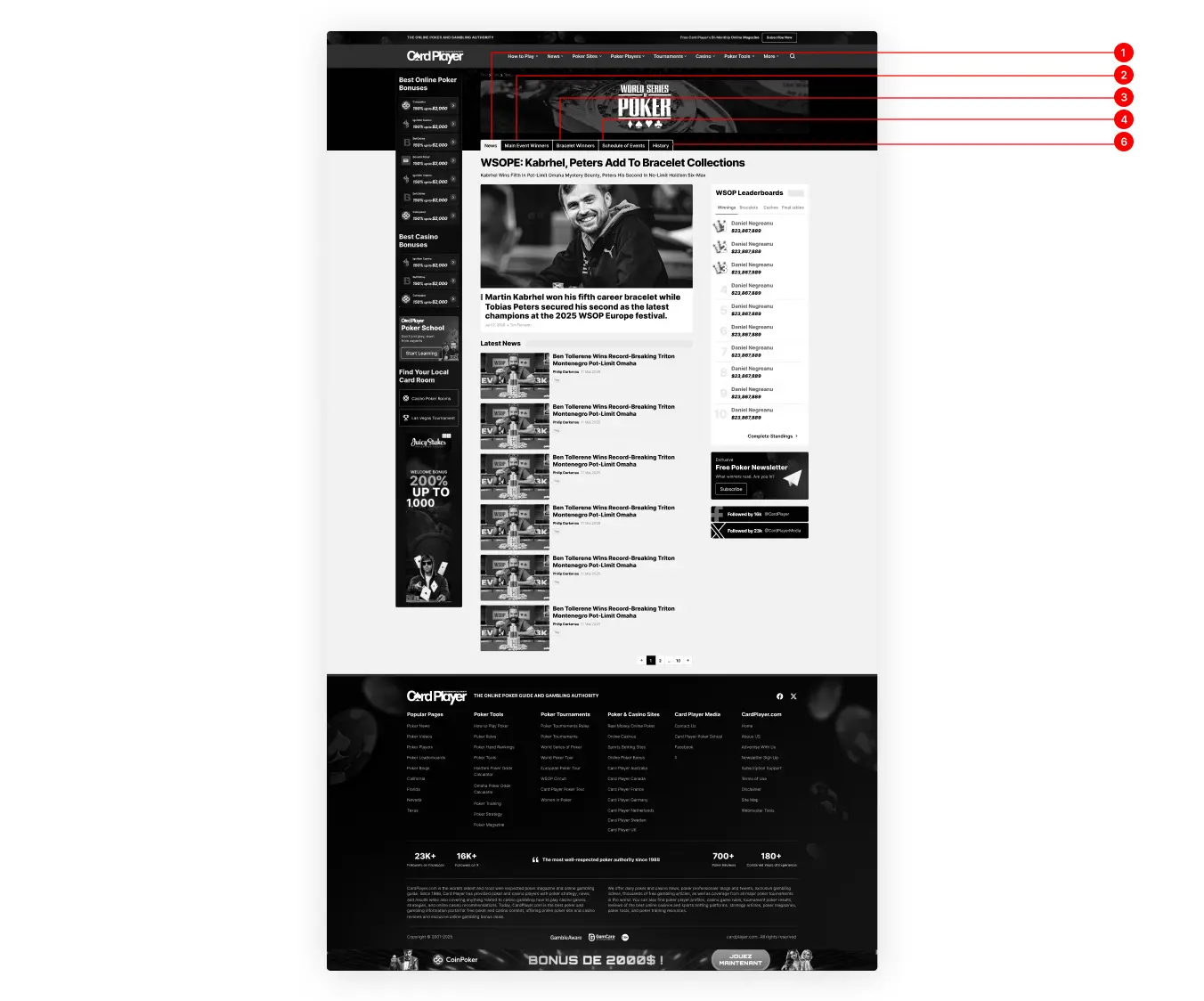
  • 2. Tournament template rework

    📔 Context

    Tournament content is high-intent and information-dense. Legacy implementation tended to split behaviors across multiple layouts and variants.
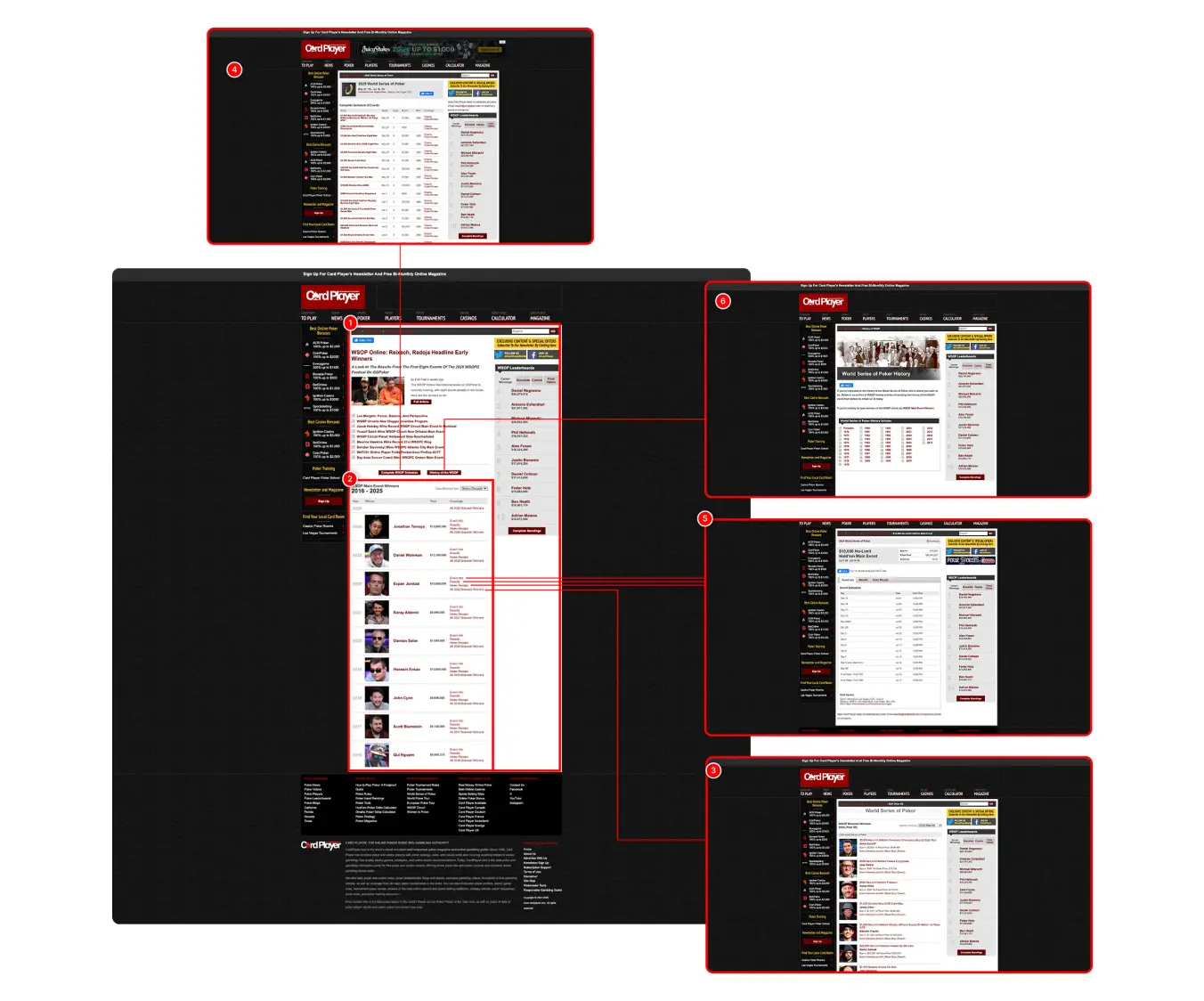
    ℹ️ Tournament content was fragmented across multiple page types and navigation paths (news, winners, schedules, history), forcing users to bounce between templates to understand one event

    🚨 Problem

  • Multiple competing layouts to cover tournament needs (news, winners, schedule, history, tournament type etc…)
  • Variation layers made the template hard to scale across tournaments and harder to maintain
  • Users and editors lacked a predictable structure, increasing drift over time
  • 💊 Solution

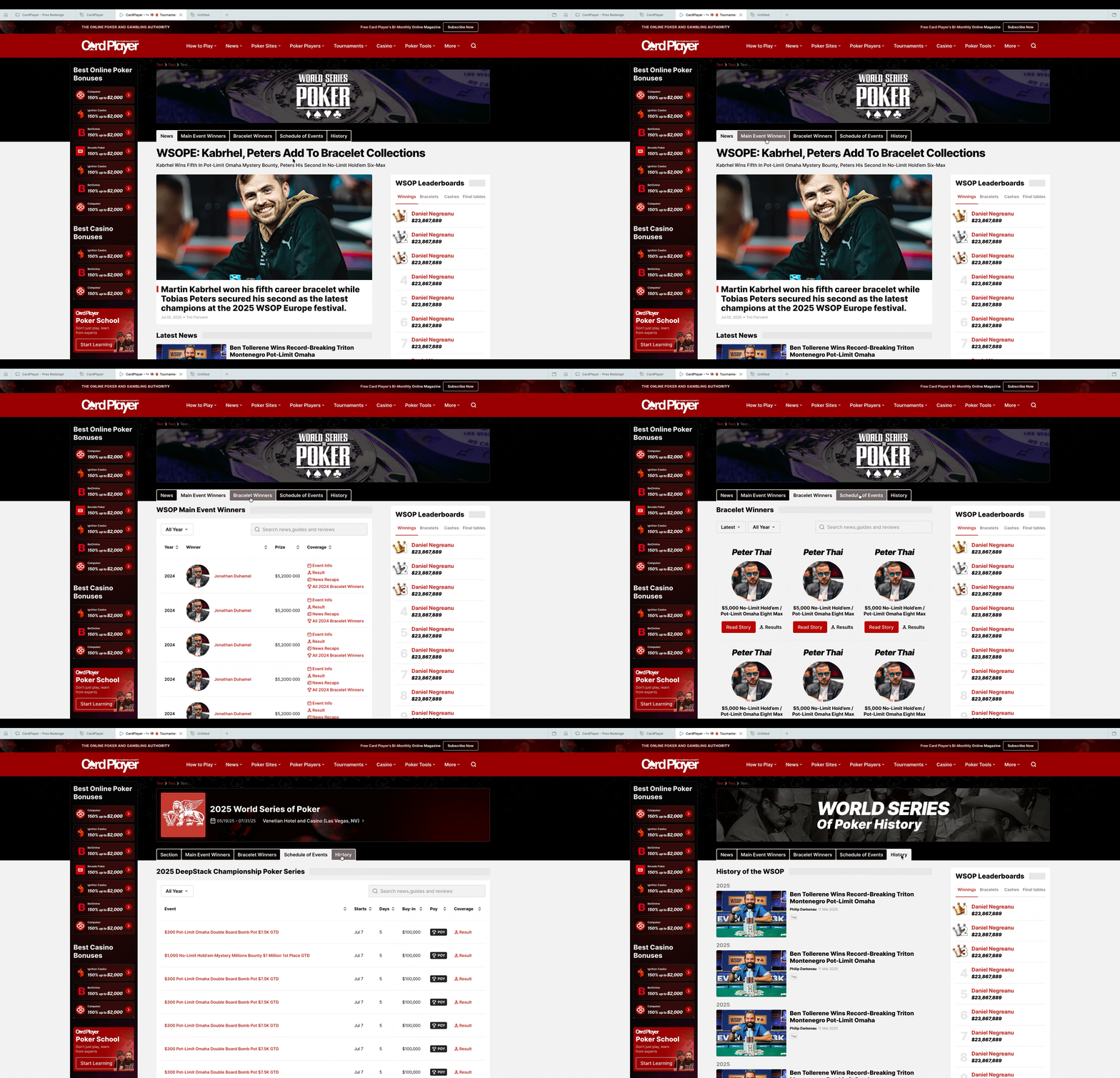
  • Consolidated tournament behaviors into one hub-style template with explicit content pillars
  • Standardized navigation structure to reduce the need for separate layouts (News, Main Event Winners, Bracelet Winners, Schedule of Events, History)
  • Reduced variation layers by defining a single scalable skeleton with modular sections
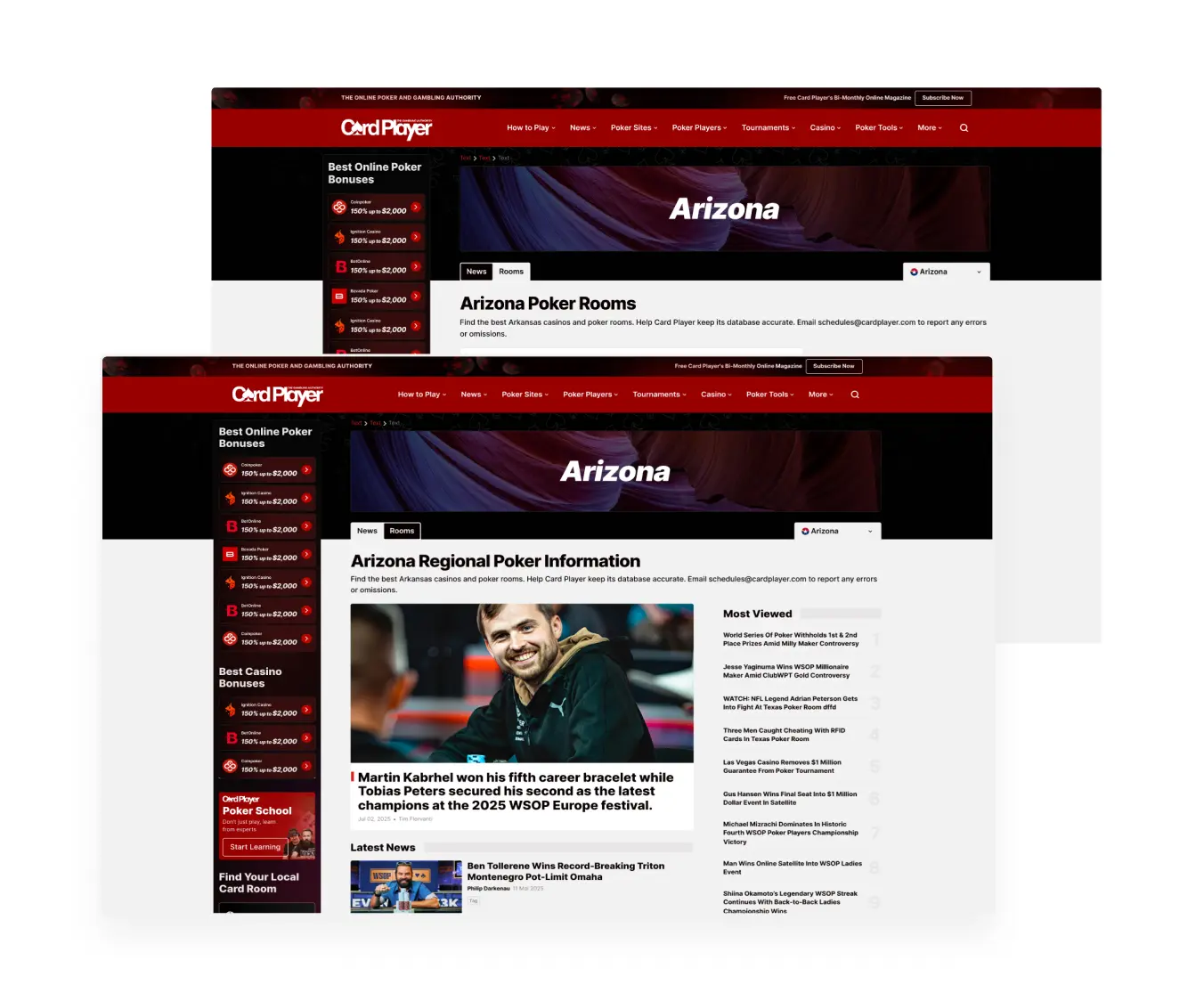
  • 3. Region template rework

    📔 Context

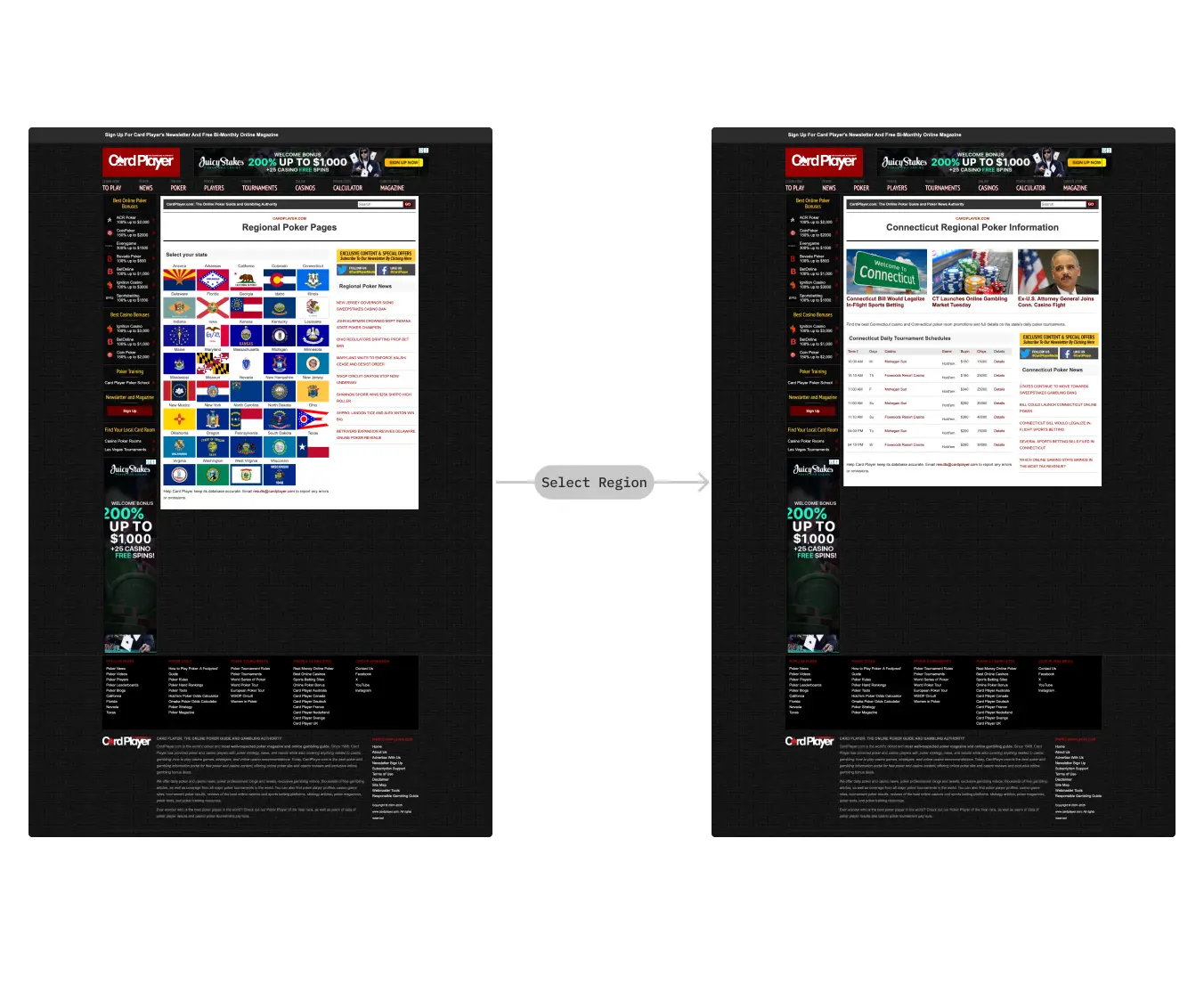
    Region browsing is a high-intent entry point (local poker rooms + regional news). The legacy implementation mixed content types and didn’t reuse a canonical listing patterns, creating inconsistency and poor discoverability.
    🚨 Problem

  • No reusable archive/list pattern: region pages were treated as one-offs, mixing news and rooms without a clear structure
  • Switching context was heavy: region selection and content-type navigation (news vs rooms/tournaments) wasn’t predictable, increasing friction and variation layers
  • 💊 Solution

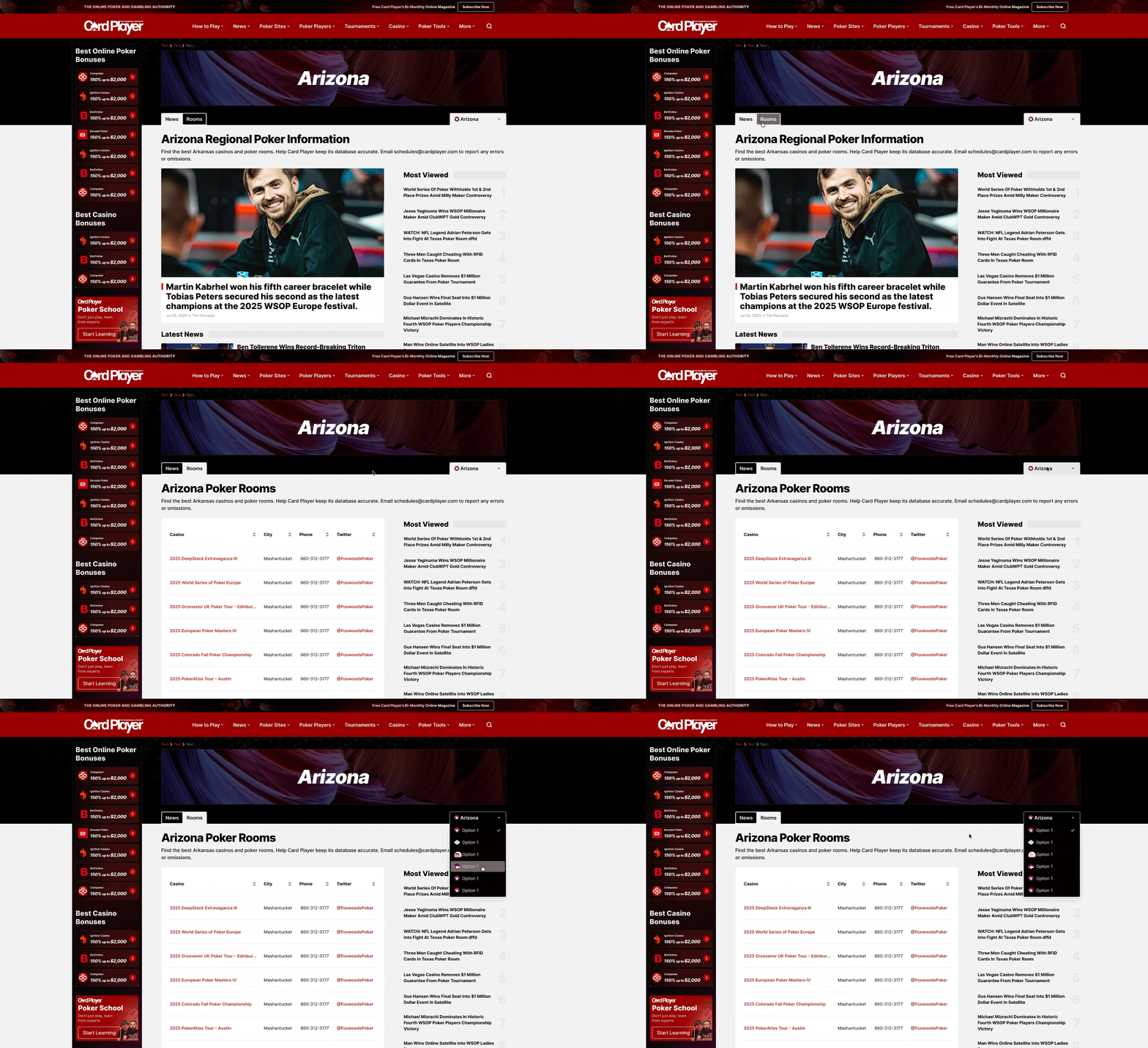
  • Rebuilt the region experience as a structured index: pre-selected region landing with clear entry to the goal (regional news)
  • Added a simple content switch: tabs to move between News and Rooms (and related regional tournament content where relevant)
  • Restored reuse by plugging the page into canonical archive/list patterns + a single region dropdown for switching countries/states without creating new templates
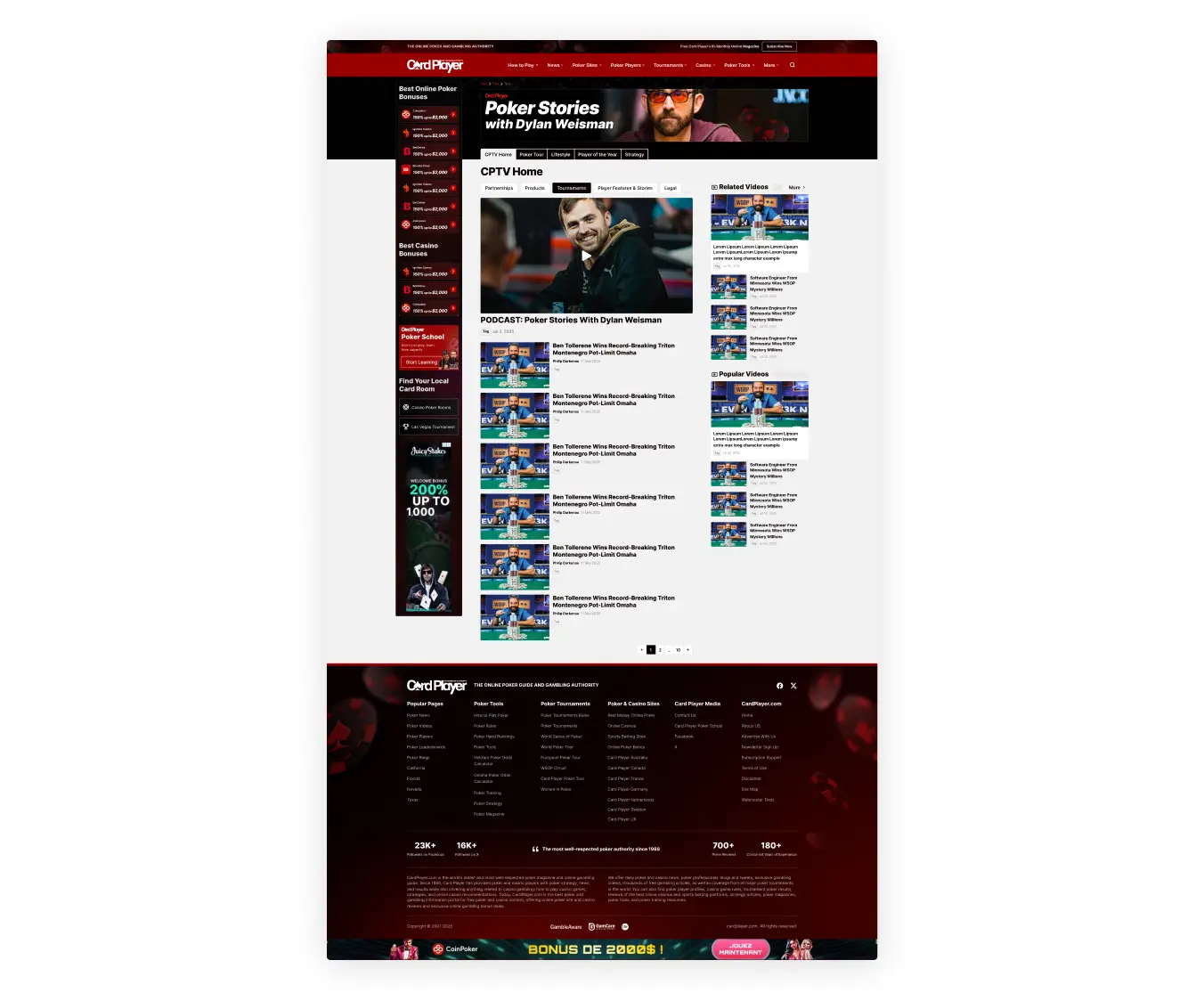
  • 4. CPTV template consolidation rework
    📔 Context

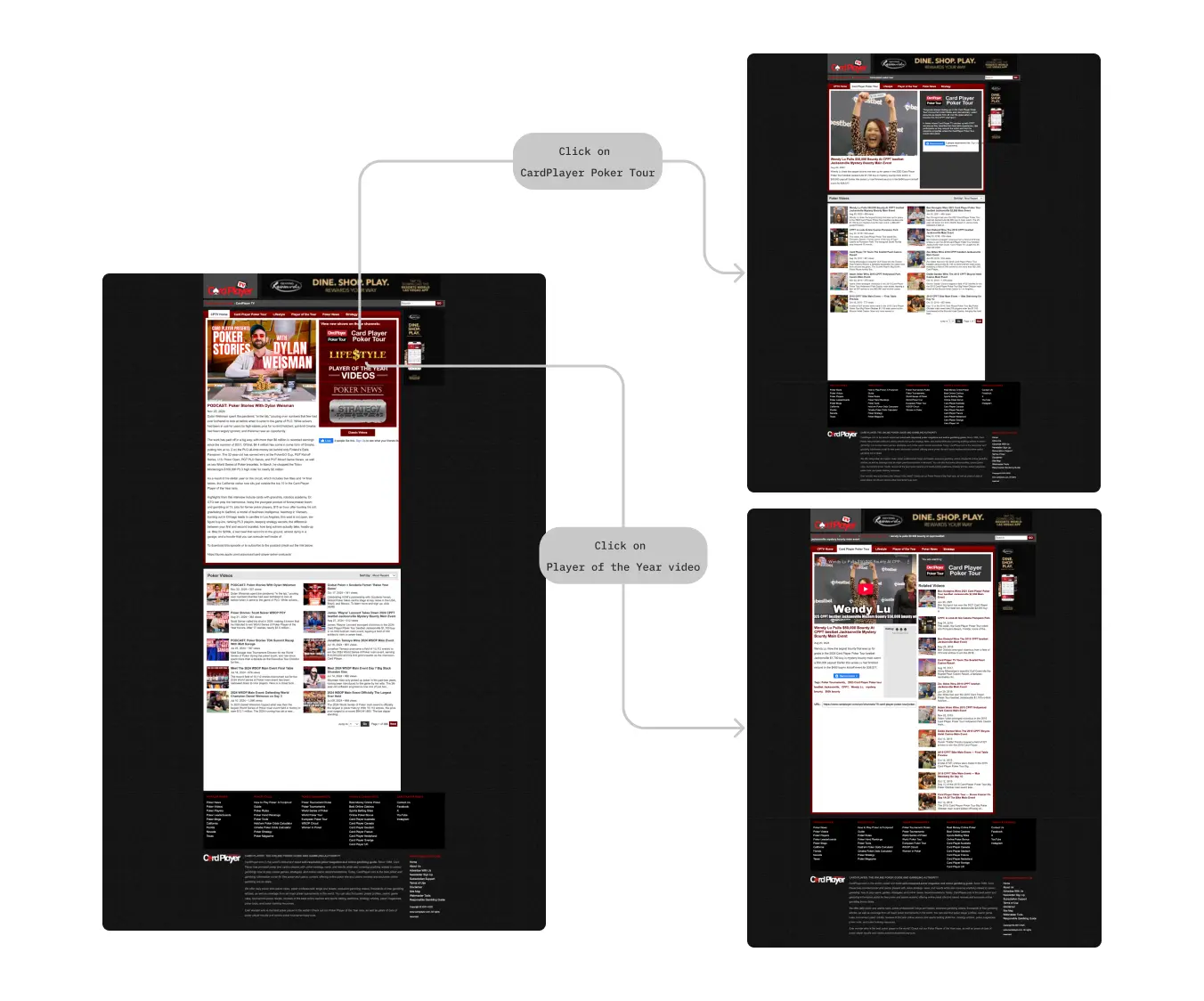
    CPTV existed through several separate layouts, fragmenting the experience and creating a high maintenance surface.

    🚨 Problem

  • Different CPTV layouts for related intents, multiplying template pages and variant layers
  • Inconsistent entry points and navigation triggers encouraged drift and new one-offs
  • Any UI update required repeated work across parallel layouts
  • 💊 Solution

  • Consolidated CPTV into a constrained layout system and reused canonical patterns
  • Standardized key entry points and navigation triggers (tour, videos, highlights) within one scalable model
  • Reduced template variation count by merging everything in 1 scalable skeleton with modular sections
  • 📊
    Measurable Results:
  • Magazine: 3-page journey → 1 unified template (latest + search + issue summary in one place) → fewer clicks to reach “read/download”, clearer path to print subscription CTA
  • Tournaments: multiple layouts → 1 hub template with fixed pillars (News, Winners, Schedule, History) → predictable navigation, easier to scale across events without creating new variants
  • Regions: mixed, hard-to-scan pages → 1 structured Region template (pre-selected region + clear tabs + canonical listings) → clearer information hierarchy with regional News and Tournaments surfaced first, making high-intent content faster to access than before
  • CPTV: parallel layouts → 1 constrained skeleton with standardized entry points (tour, videos, highlights) → fewer branches to maintain, consistent navigation across video content
  • System-level outcome: reduced variation layers on the highest-complexity surfaces, meaning future updates require 1 template change per surface instead of maintaining multiple competing layouts
  • Mission 4: Governance, delivery efficiency, and stakeholder visibility

    📒
    Context

    As the redesign progressed, the main risk shifted from design quality to execution: misalignment between Product SEO, PM, and Design on what “done” meant and what should ship first, plus a lack of shared visibility on WIP. The team was not operating with a redesign program mindset, so decisions drifted and progress was hard to communicate.

    In parallel, the Figma environment created delivery friction: the legacy and new versions were mixed in the same file, which polluted the workspace and made it hard to isolate the redesign the way I normally do. Branching was not adopted as a standard workflow, so I had to drive governance, protect handoff clarity, and prevent future rework.

    Finally, system scalability became a senior-level constraint: at CardPlayer scale, component and organism design can explode into variants and slow down the entire file if not managed with explicit rules.

    🎯
    My daily tasks
  • Ran alignment loops between Product SEO Director, PM, and Design to lock scope, priorities, and a shared definition of “done” as the redesign evolved
  • Built a macro WIP tracking system to communicate progress, priorities, and blockers to stakeholders beyond Jira ticket-level visibility
  • Cleaned up and restructured the Figma workspace to reduce noise from the legacy version and keep the redesign implementable
  • Pushed for workflow discipline to isolate the new redesign workstream and stabilize handoffs despite limited branching adoption
  • Defined component scalability rules to decide when to use organism variants vs modular swaps (preventing variant explosion)
  • Documented implementation rules (canonical vs variants, module swap logic, components strategy) to reduce churn and stop design debt from coming back
  • 1.Built macro governance on top of Jira


    📔 Context

    Jira tracked micro delivery (tickets, status, assignees), but the redesign was a program: stakeholders needed a macro view of scope, priorities, dependencies, and remaining work across multiples templates.

    🚨 Problem

  • No macro visibility -> hard to answer “what’s done, what’s next, what’s blocked” at program level
  • Without a global view, teams tend to ship fast local fixes, creating inconsistent templates and accumulating design debt
  • Progress needed to be measured by effort, not only by number of pages, since templates don’t require the same level of work
  • 💊 Solution

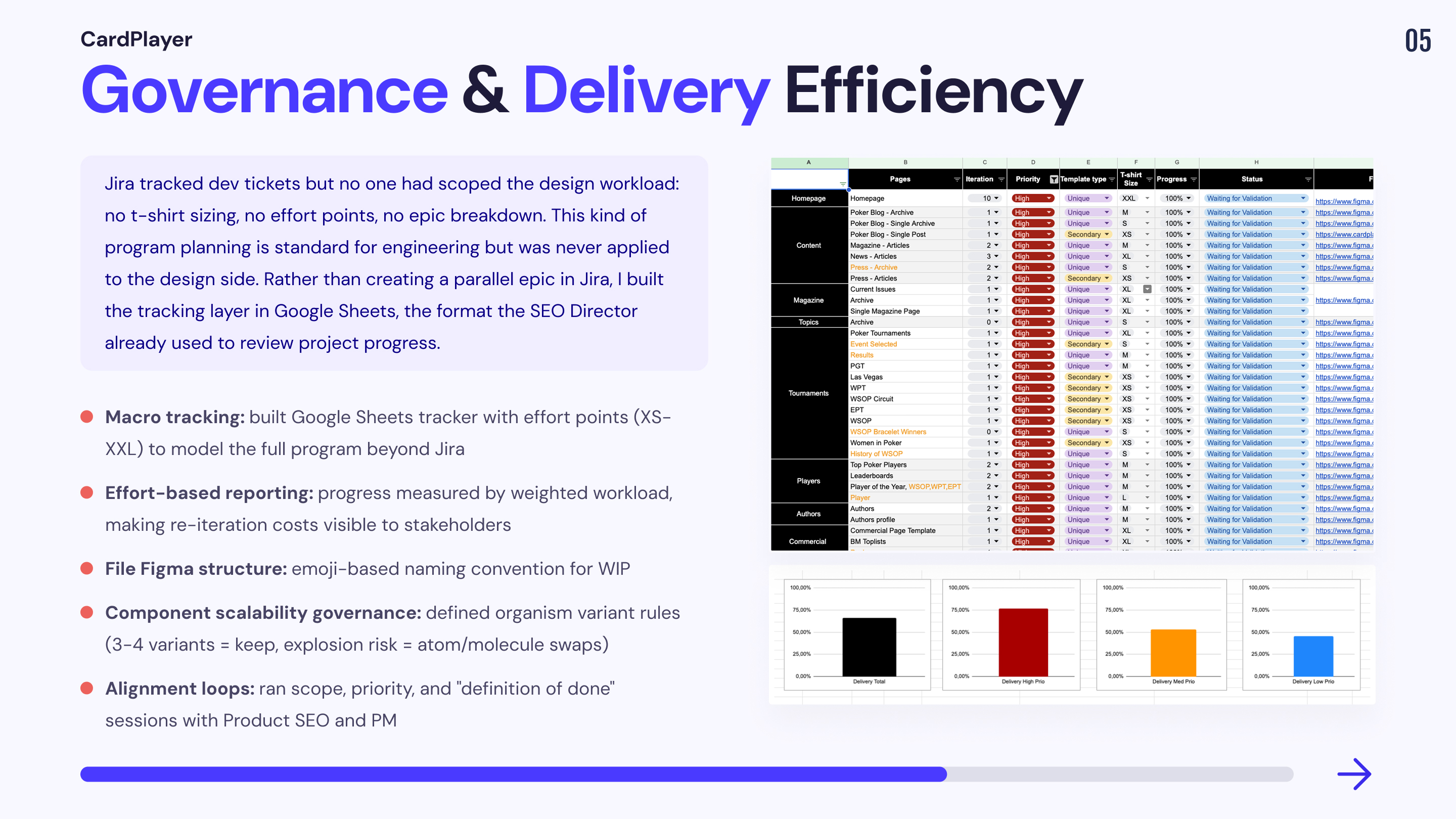
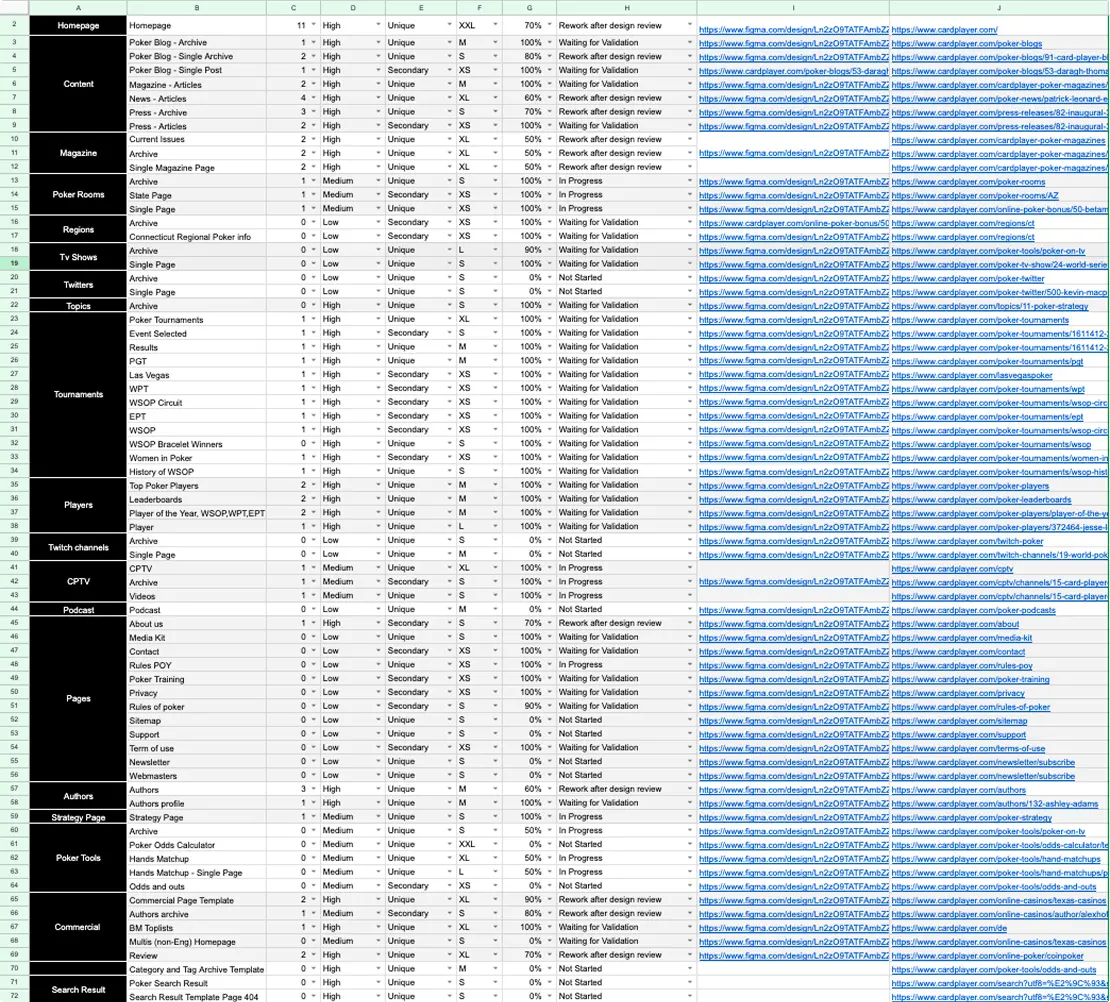
  • Built a Google Sheets tracker to model the redesign program end-to-end (Desktop + Mobile)
  • Tracked templates by priority tiers (High/Medium/Low) and weighted each template using effort points to reflect real workload
  • Used the tracker to align scope, sequencing, and stakeholder expectations alongside Jira execution
  • Used effort points to make iteration trade-offs explicit: stakeholders could see which templates consumed the most effort due to requested re-iterations, so scope changes and delays were decisions made with full visibility (not surprises).
  • ℹ️ Google Sheets tracking tool that I created to communicate about my work in progress. You can access the template 👉 here

    🧮
    Tracking metrics Calcul
  • Pages = number of templates fully completed
  • Effort Points = weighted workload per template (XS=1, S=2, M=3, L=5, XL=8, XXL=13)
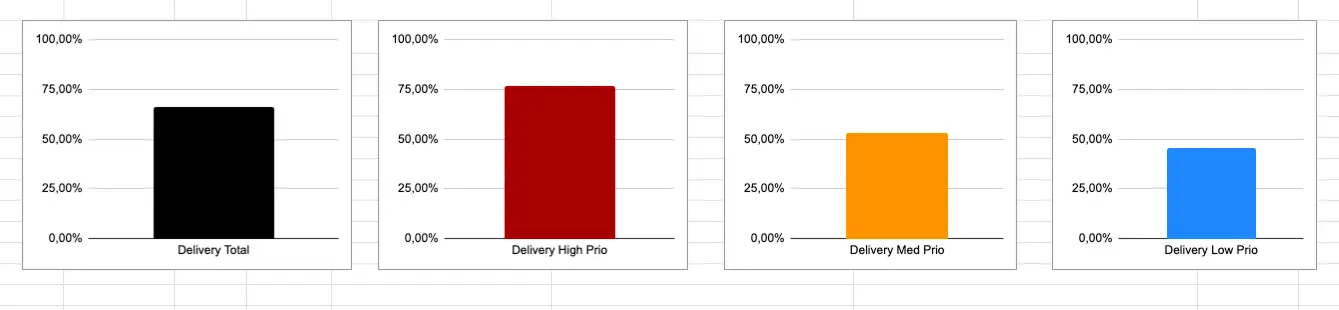
  • Delivery % = effort completed ÷ total effort (more accurate than page count when templates vary in complexity)
  • 2.File Structure & Naming Convention


    📔 Context

    When I joined, the Figma file contained the live production design system and screens. I couldn’t delete or refactor legacy styles/variables because the team still needed to ship production updates in parallel (ex: A/B tests on toplists). On top of that, the company plan didn’t allow Figma branching, so I couldn’t isolate the redesign in a clean branch the way I normally do. As stakeholders were reviewing the file directly, the lack of structure created constant confusion about what was production, what was validated for the redesign, and what was still WIP.

    🚨 Problem

  • Legacy + redesign mixed in the same file -> high risk of using the wrong styles/variables and creating inconsistencies
  • No branching -> impossible to “freeze” handoff-ready work while continuing exploration elsewhere
  • Stakeholders lacked WIP clarity -> hard to tell status, priority, and what needed validation
  • File noise slowed delivery -> harder reviews, more back-and-forth, higher chance of mistakes
  • 💊 Solution

    Solution

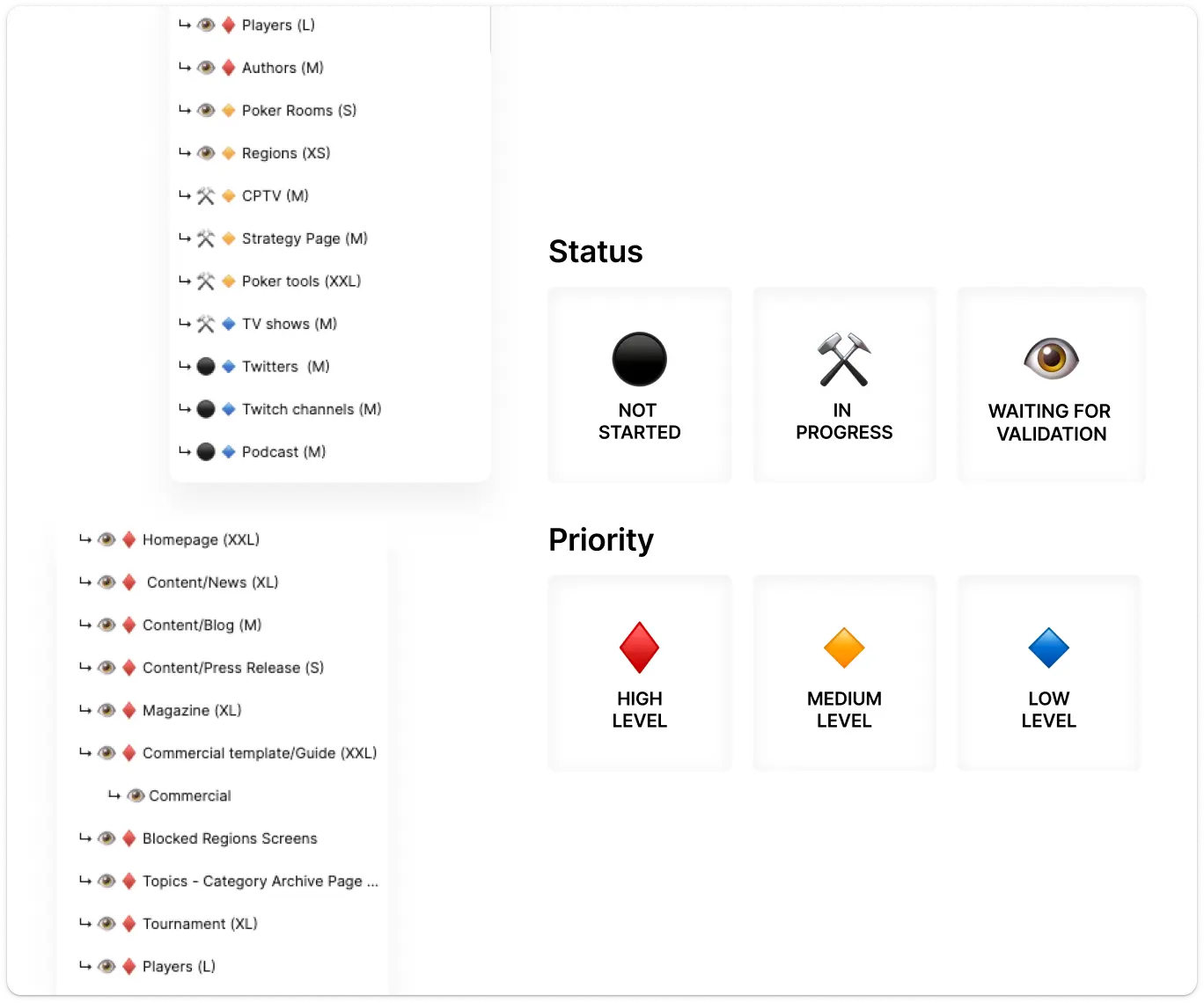
  • Implemented an emoji-based naming convention to make WIP instantly readable in the page list: Status (● Not Started, 🛠 In Progress, 👁 Waiting for validation) and Priority (🔺 High, 🔸 Medium, 🔹 Low)
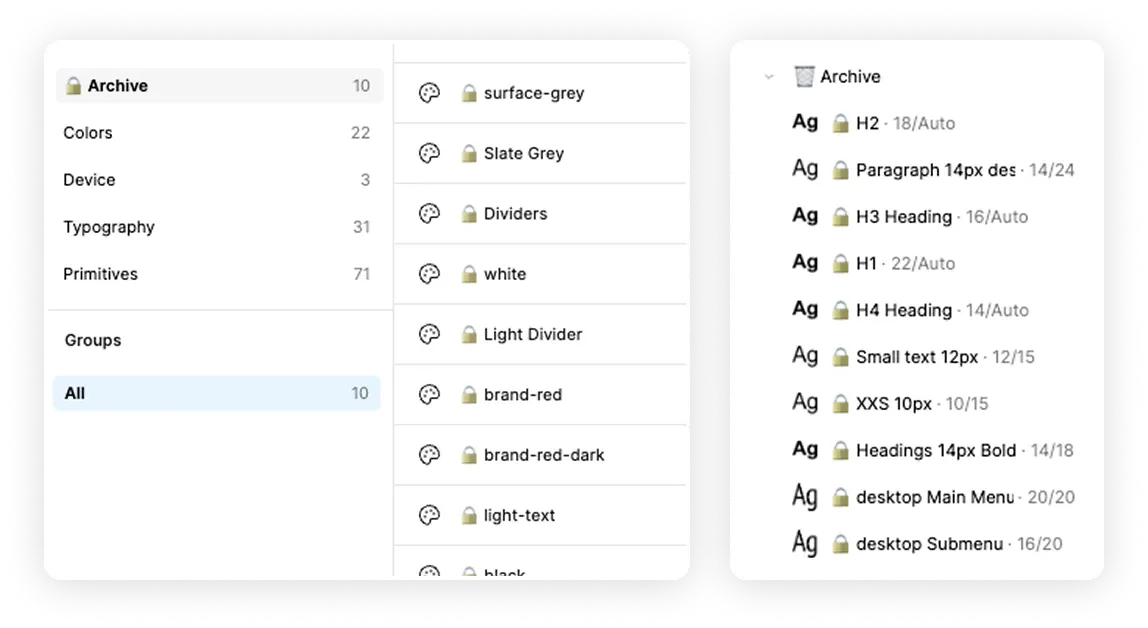
  • Introduced locked legacy style/variable conventions ‘🔒’ to clearly signal “do not touch / not for redesign use”
  • Structured pages and sections to separate production references from redesign workstreams
  • Retrospective improvement noted: would push for a dedicated redesign file or branch-enabled workflow to fully isolate new foundations and stabilize handoffs
  • 3.Components & Memory Usage Optimisation


    📔 Context

    At CardPlayer scale, the risk isn’t “missing components”, it’s overbuilding organisms. Too many heavy organism variants make the file slow, hard to maintain, and difficult for another designer to take over. The goal was to keep the system reusable while keeping Figma performance and handover clarity high.

    🚨 Problem

  • Organism variant explosion increases file weight and slows iteration
  • Large variant sets are hard to maintain, and updates stop propagating cleanly
  • Without a clear rule, teams either over-componentize (bloated file) or duplicate locally (system breaks)
  • 💊 Solution

    Keeping Organism variants under control
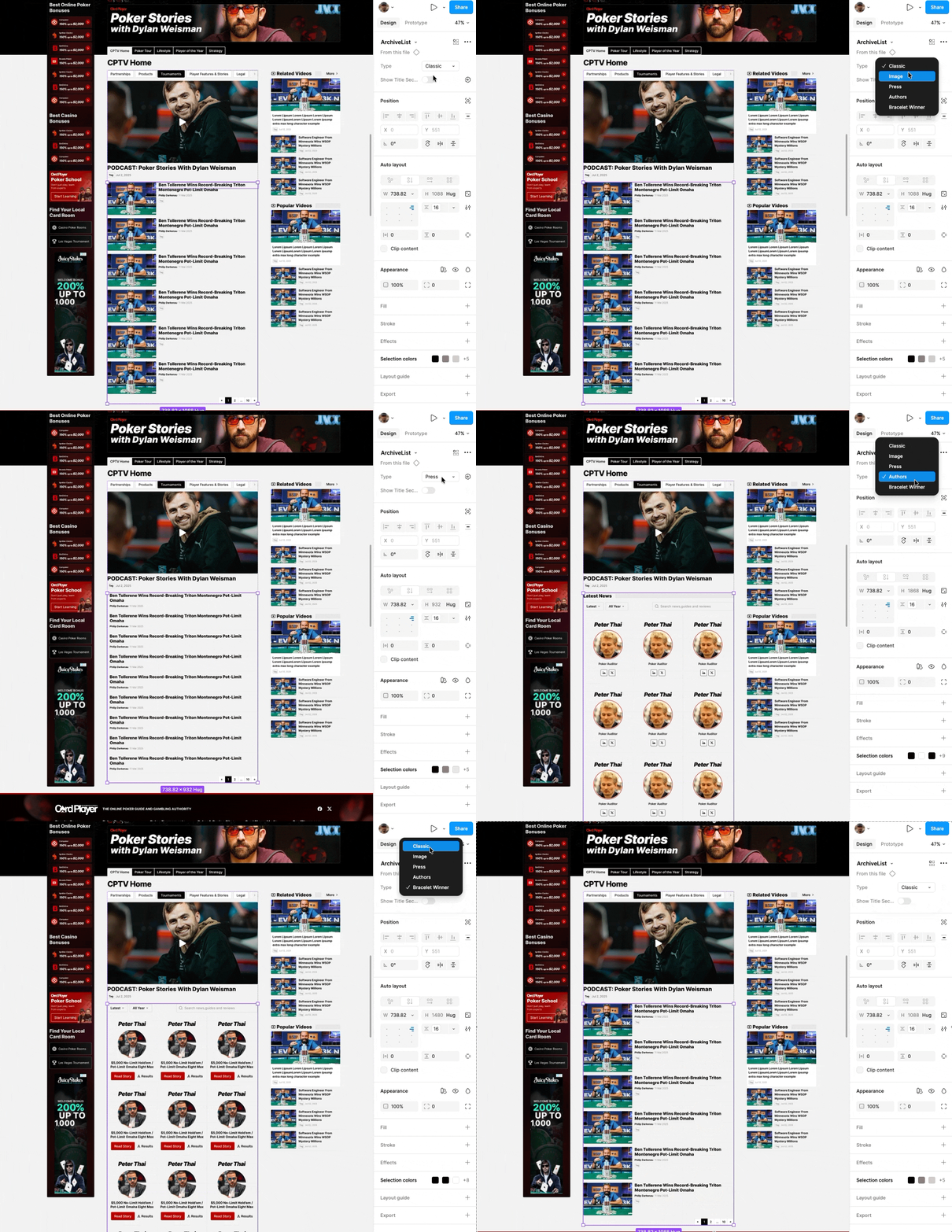
    If 3–4 variants cover the need: keep controlled organism variants (file stays manageable)

    Atomic & Molecular level optimisation
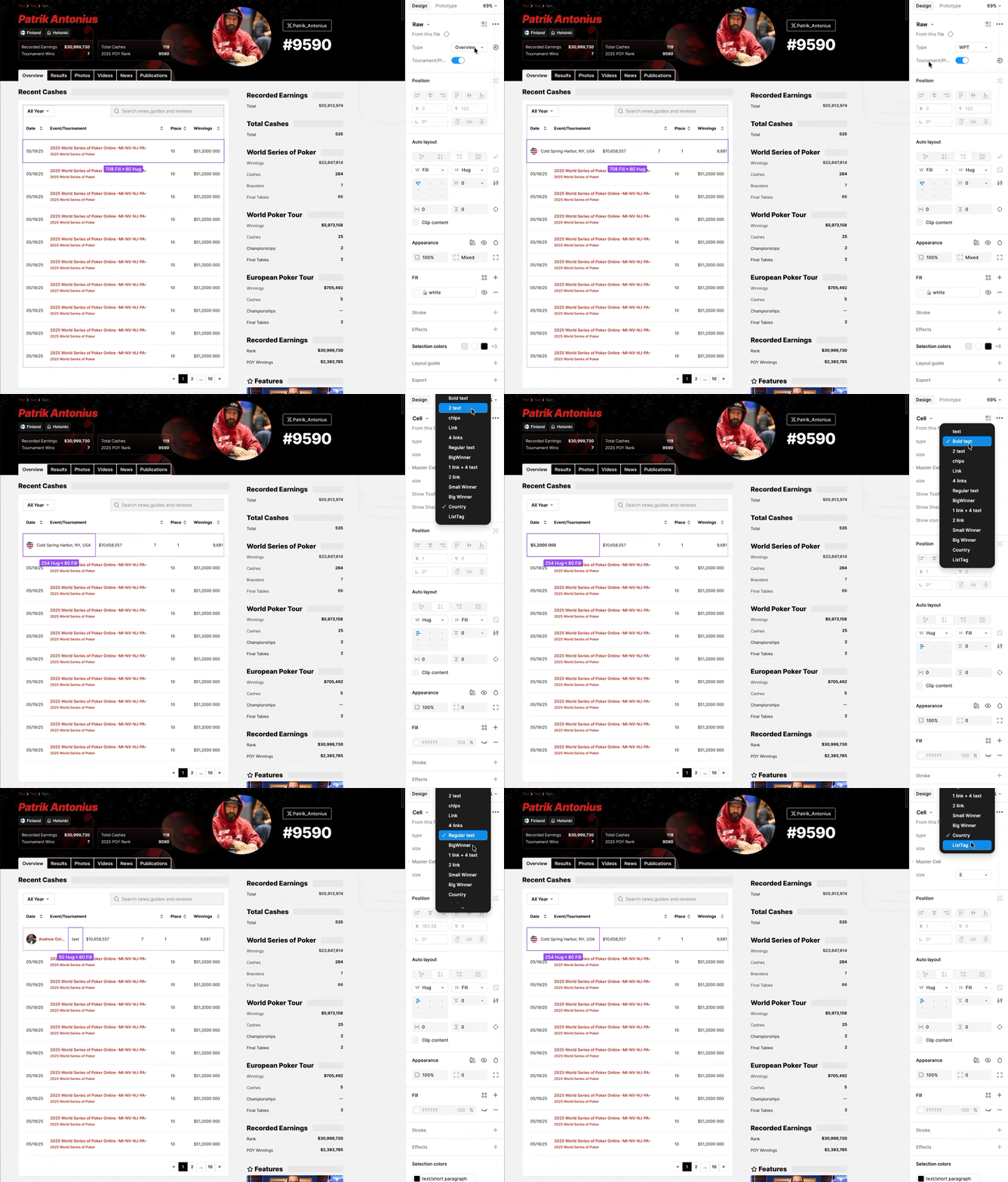
    If variants would explode: build one master organism and generate variations by swapping molecules/atoms directly in context (“one master to rule them all”)

    📊
    Measurable Results:
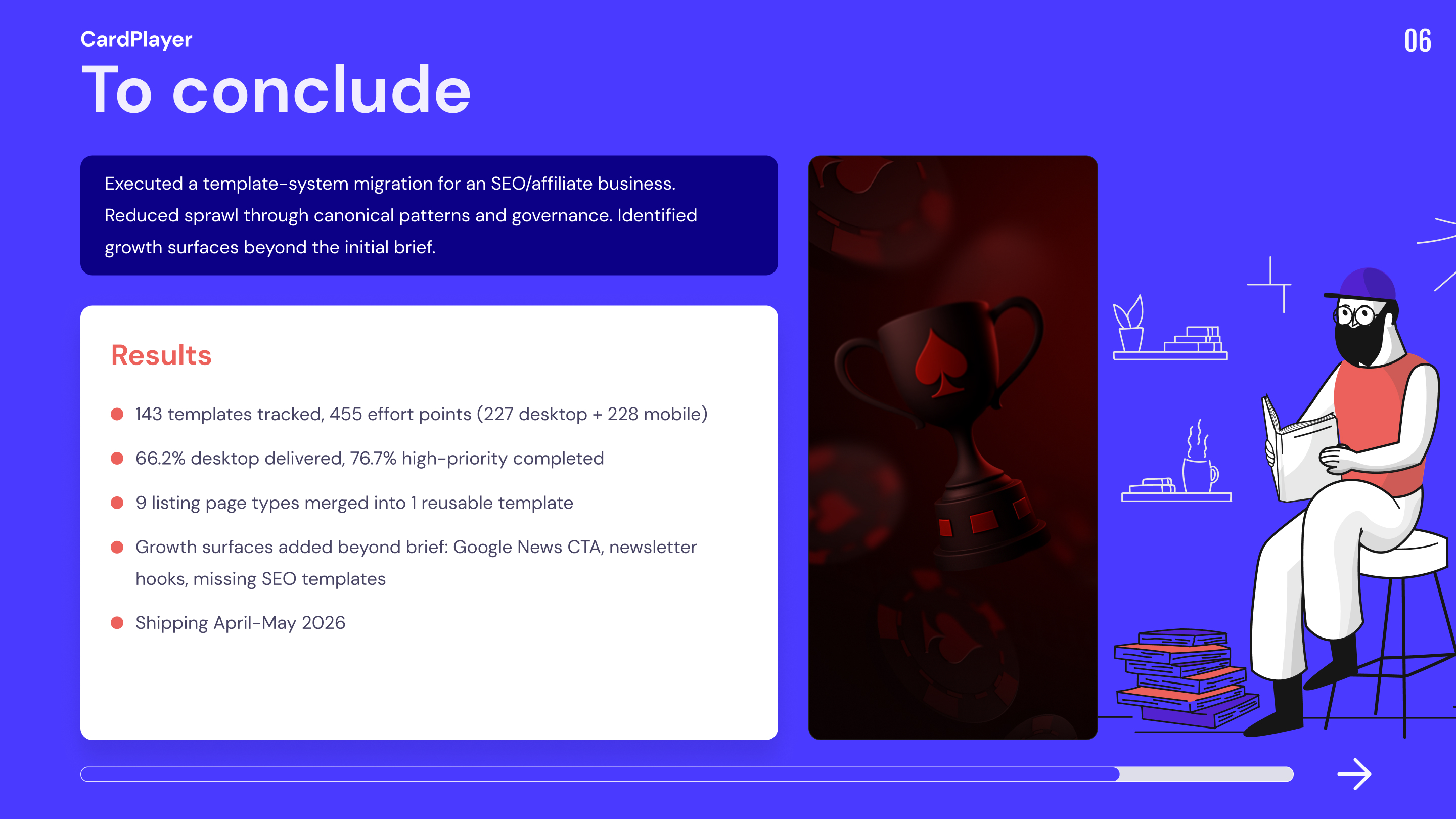
  • 455 effort points modeled across the redesign program (227 desktop + 228 mobile) to quantify total workload and scope
  • 143 templates tracked end-to-end (71 desktop + 72 mobile) with a single macro view beyond Jira
  • Effort-based delivery reporting implemented: progress measured by weighted workload (XS–XXL) rather than raw page count
  • Iteration transparency enabled: effort points made re-iteration cost visible, so trade-offs and delays were decided with stakeholders in full awareness
  • 100% WIP readability in Figma pages through emoji-based status/priority naming (Not started / In progress / Waiting for validation + High/Medium/Low)
  • Variant explosion prevented via an explicit scalability rule (controlled organism variants vs atom/molecule swaps), keeping the file maintainable and handover-ready
  • Key Result


    🚀
    CardPlayer redesign was executed as a template-system migration for an SEO and affiliate-driven business. I reduced template sprawl through canonical patterns, rebuilt high-complexity templates into scalable skeletons, and embedded governance so stakeholders could track scope and trade-offs in real time. Beyond restructuring, I identified and introduced additional monetization and growth surfaces through competitor benchmarking (proven affiliate patterns), then optimized UX to route users more intelligently toward revenue pathways (offers, subscriptions, tools, and high-intent content).
    📈
    Success metrics (post-launch) to control
  • Affiliate CTR on priority templates (homepage, reviews, tools entry points)
  • Organic sessions and SERP CTR on reworked hubs and archive families
  • Newsletter and Google News subscriptions as repeat traffic indicators
  • Outcomes

  • Scope governed at scale: 143 templates tracked end-to-end with 455 effort points (desktop + mobile) and priority tiers, giving macro visibility beyond Jira
  • Delivery at handoff (desktop): 66.2% completed (90/227 effort points, 39/71 templates) with 76.7% high-priority desktop completed (61/138 points, 23/37 templates)
  • SEO scalability: 9 archive families → 1 canonical archive/list skeleton, reducing fragmentation on the largest repeated surface area
  • Variation layers reduced on key hubs: Magazine/Tournament/Region/CPTV reworked into single scalable models instead of parallel layouts
  • Growth readiness added beyond the brief: trust blocks standardized, newsletter + Google News subscription hooks, tools/guides surfacing, and missing SEO templates identified (taxonomy archives, search results)
  • Process constraints

  • Paused before 100% delivery due to budget-driven team reduction, limiting reporting to system/delivery KPIs rather than live performance
  • No post-launch instrumentation yet: affiliate CTR, scroll depth, organic sessions and SERP CTR impact remain pending deployment
  • Snapshot at handoff: some high-priority templates were reopened for late-cycle iterations after stakeholder reviews.